
The Office of the Special Prosecutor (OSP) has indicated that it will prosecute six former senior public officials, including the former Minister of Finance, Ken Ofori-Atta, for their alleged roles in what it describes as the unlawful and wasteful engagement of Strategic Mobilisation Ghana Limited (SML) in revenue assurance contracts with the Ghana Revenue Authority (GRA).
The prosecutions are expected to start before the end of November 2025 following what the OSP described as “overwhelming evidence” of procurement irregularities, poor value-for-money outcomes and undeserved payments to the company.
The other officials to be charged are the Chef de Cabinet to Ken Ofori-Atta as Minister of Finance, Ernest Akore; former Commissioner-General of the GRA, Emmanuel Kofi Nti; former Commissioner-General of the GRA, Ammishaddai Owusu-Amoah; former Commissioner of the Customs Division and current General Manager of SML, Isaac Crentsil; and former Commissioner of the Customs Division and current Member of Parliament for Jaman South, Kwadwo Damoah.
SML payments
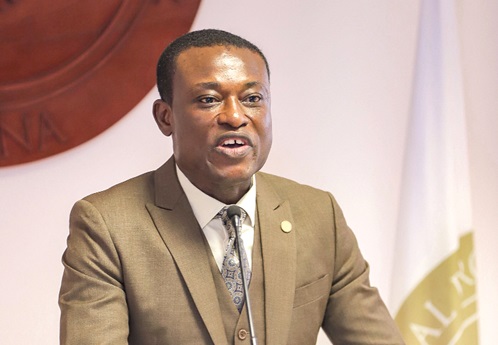
Addressing a news conference in Accra yesterday, the Special Prosecutor (SP), Kissi Agyebeng, said the six would face corruption and corruption-related charges, and that his office would seek to recover financial losses caused to the country through the controversial SML contracts.
Mr Agyebeng said he would also pursue the recovery of GH¢125 million from SML itself, describing the amount as unjust enrichment resulting from overpayments made for services that were either substandard, minimally performed, or not rendered at all.
He said investigations by his outfit revealed that SML’s involvement in the country’s revenue assurance operations was based on automatic payments detached from performance, adding that the company failed to provide verifiable reports to justify the large sums received from the GRA.
“It emerged that SML had no proven record of technical capability, financial strength or experience when it was first submitted to the Public Procurement Authority (PPA) for approval in 2017.
“At that time, it was barely four months old and had been rejected several times by the PPA for lacking the necessary capacity to undertake revenue assurance functions. Despite these rejections, the company was later awarded contracts to perform transaction audits and external price verification services,” Mr Agyebeng indicated.
He said the company’s monthly audit reports were unreliable, adding that its metering systems were unsuitable for use at several petroleum depots, and that it could not integrate its operations into the Integrated Customs Management System (ICUMS) and the Electronic Reconnaissance and Data Monitoring System (ERDMS).
“The investigation further revealed that SML received payments from the GRA without submitting invoices backed by verified reports as required by procedure. This payment structure created room for free and undeserved transfers of public funds, resulting in significant financial losses to the state,” he said.
KPMG findings
While parts of the OSP’s findings aligned with the audit report, on SML by KPMG, an audit firm, the Special Prosecutor disagreed with several of the firm’s conclusions, particularly in relation to accountability, performance and value-for-money.
He said KPMG’s report was placatory in material respects, suggesting that it attempted to sanitise SML’s role by ignoring the company’s lack of independent audit tools and its redundancy, alongside existing systems like ICUMS and ERDMS.
Mr Agyebeng said there was no causal relationship between SML’s operations and the reported improvements in petroleum sector revenue as those gains were largely attributed to macroeconomic factors, increased taxes, and better regulatory enforcement, rather than SML’s interventions.
Reckless financial decision
He further stated that while KPMG concluded that SML was not paid between April and October 2019, its investigation found that the company actually received over GH¢29 million within that period.
He also highlighted a Memorandum of Understanding signed in November 2024 between the Ministry of Finance, GRA and SML to change the company’s variable fee structure to a fixed monthly fee of $1.43 million, inclusive of taxes.
Mr Agyebeng criticised the move as unnecessarily deceptive, insisting that it sought to institutionalise large payments in foreign currency despite the company’s poor performance.
He said GRA had not made any payments to SML since December 2024 following the commencement of its investigation.
Recommendations, commendations
The Special Prosecutor commended the GRA for terminating SML’s transaction audit and external price verification contracts in November 2024, describing the action as appropriate and necessary in view of the company’s failure to perform.
It, however, advised that any future engagement of SML or similar entities should be preceded by a comprehensive needs assessment, strict adherence to public procurement regulations, and a robust value-for-money evaluation to ensure accountability and efficiency in the use of public funds.
The Special Prosecutor emphasised that the office remained committed to ensuring accountability, integrity and transparency in the management of public resources and to holding all individuals involved in the SML scandal to account.
