
Participatory spatial planning key to coastal resilience — Experts
Experts in climate change and development planning have called for the adaptation of a participatory spatial planning approach to help address the negative impact of climate change on coastal communities in the country.
They said apart from ensuring that key local actors played crucial roles in land use planning within their jurisdictions, their knowledge should be integrated into interventions targeted at building resilience against the global crisis.
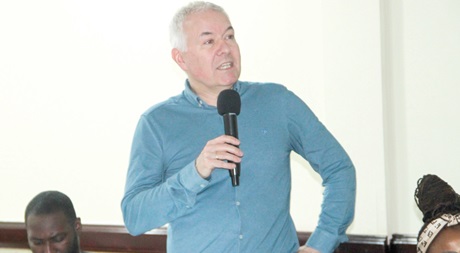
The experts were the Director of Environment at the Ministry of Environment, Science and Technology (MEST), Peter Dery; a senior Human Settlement Officer at UN-Habitat, Mathias Spaliviero, and an associate Professor of Spatial Planning Support Systems and Institutionalisation at the University of Twente, Netherlands, Dr Luc Boerboom.
They stressed that the extent to which coastal communities in West Africa, including Ghana, were being impacted by sea-level rise and coastal erosion posed an existential threat that needed urgent attention.
The experts, therefore, called for the strengthening of collaboration between state and non-state actors, as well as local communities, to implement nature-based solutions.
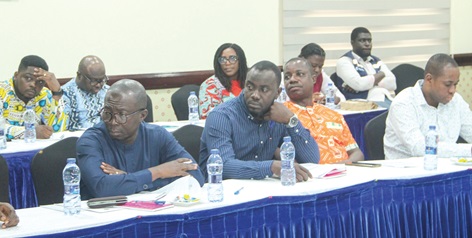
They were speaking at the second session of a steering committee of the Improved Resilience of Coastal Communities in Côte d'Ivoire and Ghana project in Accra yesterday.
Context
Coastal communities in Ghana and Côte d'Ivoire are highly vulnerable to the effects of climate change, including sea-level rise, coastal erosion, and extreme weather events.
It was in that regard that the "Improving the resilience of coastal communities in Côte d'Ivoire and Ghana" project was conceived and is being implemented to help reduce the vulnerability of small and medium-sized coastal communities.
The about $14-million project, which is being implemented by UN-Habitat, was approved in August 2023 and started in September 2024.
The project, which is expected to be delivered by 2029, was designed to protect vulnerable, low-lying communities from climate-driven erosion, floods, and sea-level rise.
It is focused on highly vulnerable coastal zones, specifically targeting 21 communities across Ghana and Côte d'Ivoire.
In Ghana, the project is being implemented in 11 communities, including areas in the Greater Accra and Volta regions.
The two main objectives of the project are to strengthen regional coordination and strategic planning through a cross-border coastal development strategy and the sharing of good practices, as well as strengthening local adaptation capacities by developing spatial planning schemes, implementing concrete interventions (infrastructure, early warning systems, alternative livelihoods) and supporting local governance.
The committee looked at the progress of work and the way forward for the successful implementation of the project. Mangrove plantations were being piloted in some of the coastal communities ahead of a possible scaling up.
Participatory approach
Mr Spaliviero said a participatory planning approach that allowed both expert knowledge and local views to be integrated for building climate resilience was the ideal way to protect citizens from negative climate impacts.
“If we have methodologies that allow us to plan with the people living in those areas, they will understand that whenever they engage in agriculture along the coastline, it will worsen their vulnerability; that way, they will be responsible for their decisions,” he said
For his part, Mr Dery said the continuous encroachment of the country’s coastline and the increasing loss and damage associated with climate change in coastal communities required concerted efforts by all stakeholders.
He described the project as a step in the right direction since it would help reduce climate impact in coastal areas.
In his presentation, Prof. Boerboom said that although the project was progressing well, there was a need for enhanced stakeholder collaboration to consolidate the gains.
He said data creation and management were key to the success of the project, particularly when it was being done in different jurisdictions.
