
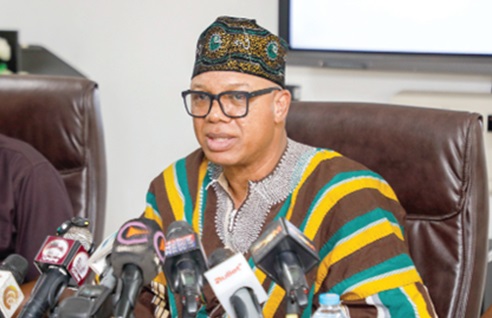
130 Million daily deficit impacting reliable water supply — GWL MD
The country is facing a water production deficit of 130 million gallons a day, affecting service reliability and equitable distribution.
While national daily demand for water stands at approximately 350 million gallons, existing treatment facilities are able to produce only 220 million gallons, creating the deficit.
The Managing Director of the Ghana Water Limited (GWL), Adam Mutawakilu, who disclosed this at an event yesterday, said in addition, non-revenue water and commercial losses levels recorded 52 per cent.
“In the Accra–Tema Metropolitan Area alone, demand is 210 million gallons per day, while supply is only 137 million gallons, resulting in a shortfall of 73 million gallons daily.
“This means nationally, out of 220 million gallons supplied daily, 114 million gallons cannot be accounted for and only 106 million gallons are properly accounted for.”
“In the Accra–Tema Metropolitan Area, of the 137 million gallons supplied daily, 71 million gallons cannot be accounted for, leaving only 66 million gallons accounted for,” Mr Mutawakilu said.
Revenue Enhancement Teams
Inaugurating 10 Revenue Enhancement Teams, the GWL MD said the teams, an increase from the initial three set up in August last year, were part of a strategic, structured and nationwide response to protect revenue and strengthen sustainability.
“Their mandate is clear: Improve revenue collection; reduce our indebtedness, detect and eliminate illegal connections; verify meters and correct billing anomalies and support reduction of non-revenue water,” he said.
The GWL MD added that the team would also educate customers and encourage voluntary compliance, as well as strengthen accountability and transparency.
Challenges
Explaining the rationale for the setting up of the teams, Mr Mutawakilu said there were operational challenges that required a number of interventions to reverse escalating operational costs.
“The cost of treatment chemicals, electricity, fuel, spare parts and plant maintenance continues to rise sharply. These inputs are non-negotiable.
“Without chemicals, we cannot treat water. Without power, we cannot pump. Without maintenance, we risk breakdowns and service disruptions,” he explained.
Secondly, he cited aging infrastructure, saying a significant portion of the company's transmission and distribution network was decades old, with many pipelines now prone to bursts and leakages, especially during periods of high pressure.
“Every drop of treated water lost through leakage represents wasted chemicals, wasted energy and lost income,” the GWL MD added.
Also, production constraints coming from climate variability, pollution of water bodies, siltation, and rapid urbanisation have combined to place tremendous stress on the production systems.
Another challenge was customer indebtedness with outstanding arrears across customer categories now running into billions of cedis nationwide.
“These unpaid bills weaken our cash flow and limit our ability to procure inputs, maintain infrastructure and expand services,” he explained.
Digital transformation
Mr Mutawakilu explained that besides enforcement, the company had embarked on an aggressive digitalisation programme to simplify billing and payments to make them convenient, transparent and stress-free.
He said the Revenue Enhancement Teams were, therefore, to tackle commercial losses more decisively, adding that since the three were established in August last year, by the end of that year, they had uncovered 217 illegal connections, detected 239 illegal connections and prepared a total of GH¢8.6 million bills for the culprits, out of which GH¢2.1 million had been recovered.
