
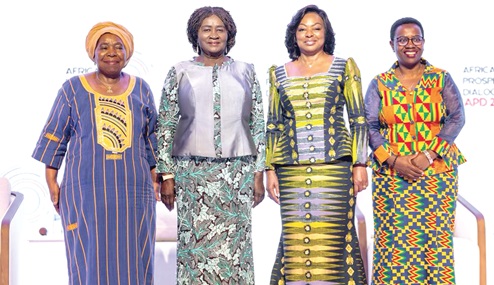
The Vice-President, Professor Naana Jane Opoku-Agyemang, has urged African governments to generate coherent medium and long-term policies and strengthen development finance institutions to support regional projects at scale.
Speaking at the opening of the 2026 Africa Prosperity Dialogues (APD) in Accra yesterday, she added that African countries must deepen integration at borders not to erase sovereignty but drive shared prosperity and economic growth across the continent.
That, the Vice-President said, would enable entrepreneurs and manufacturers to view the continent not as a series of fragmented markets, but as one connected economy or African market with vast opportunities.
“It is about enabling an entrepreneur or manufacturer, whether in Accra, Kigali or Luanda, to see Africa not as a fragmented abstraction, but as one connected market with opportunities,” Prof. Opoku-Agyemang said.
She also emphasised the need to implement industrial strategies to expand intra-Africa trade, build skills and support sustainable production to enable economies move from low productivity to higher-value activities.
Event
The three-day programme is being held on the theme: “Empowering SMEs, women & youth in Africa’s single market: Innovate. Collaborate. Trade.”
Present were the Director, Finance and Accounting, ECOWAS Bank for Investment and Development (EBID), Dr Sydney Vanderpuye; the CEO, Commonwealth Enterprise and Investment Council (CWEIC), Samantha Cohen; the CEO, Fidelity Bank PLC Nigeria, Dr Nneka Onyeali-Ikpe; the Second Deputy Governor, Bank of Ghana, Matilda Asante-Asiedu; the Commissioner for the Africa Department of Health, Humanitarian Affairs and Social Development, African Union Commission (AUC), Amma Twum-Amoah; and the Chairperson, APN Advisory Council, Dr Nkosazana Dlamini-Zuma.
24-Hour Economy
The Vice-President outlined the country’s active role in advancing Africa’s shared agenda through initiatives such as the 24-Hour Economy, aimed at unlocking productivity and removing bottlenecks that constrain businesses.
She also highlighted the government’s “Big Push” infrastructure programme, designed to lay the foundation for industrial growth while aligning Ghana’s priorities with ECOWAS and the African Union.
Prof. Opoku-Agyemang further explained that the reset vision was about shifting Africa “from dependency to self-reliance; from fragmentation to integration; from exporting potential to building prosperity at home”.
She cited Ghana’s deliberate efforts by successive governments to bridge historical and economic divides, referencing landmark initiatives such as the Pan-African Festival of Arts and Culture, the Year of Return, and the Diaspora Summit.
Prof. Opoku-Agyemang urged the continent to fully seize the transformative promise of the African Continental Free Trade Area (AfCFTA) to position small businesses, women, and young people as the cornerstone of Africa’s economic future.
Implementation of protocol
The Commissioner for Africa Department of Health, Humanitarian Affairs and Social Development, AUC, encouraged African states to implement the protocol on Free Movement of Persons, describing it as essential to making AfCFTA meaningful.
She said while 32 member states had signed onto the protocol, only four had ratified it so far. At least 15 ratifications were required for it to come into force.
The commissioner also called on African enterprises to transition from survival to scale, from informality to competitiveness, and from domestic reach to continental impact.
For her part, the Second Deputy Governor, BoG, described payment systems as more than financial tools, and called for strategic trade infrastructure essential for monetary stability, financial integration and long-term economic transformation across Africa.
She said transaction costs across African payment channels ranged between seven per cent and 10 per cent, as compared to a global average of about three per cent.
Mrs Asante-Asiedu highlighted the scale of Africa’s opportunity, describing the continent as a market of over 1.5 billion people with a combined GDP of approximately $2.8 trillion.
