
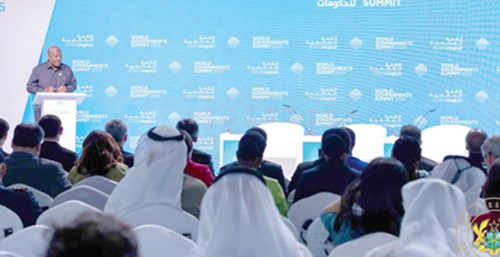
President John Dramani Mahama has called for a fundamental revision of global alliances, arguing that they must move beyond old blocs and rivalries to tackle shared existential threats and include Africa as an equal partner in shaping the future.
Addressing world leaders at the 2026 World Governments Summit in Dubai last Tuesday, President Mahama stated that the international system was at a “pivotal juncture,” requiring partnerships rooted in “shared responsibility and common destiny” rather than geopolitical competition.
“The alliances of the future must therefore be rooted in shared responsibility and based on our common destiny.
They must become alliances of solidarity, anchored in mutual respect, shared aspirations, and collective advancement,” he told the gathering of heads of states, governments and international organisations.
Africa’s role
A significant portion of the President’s address was devoted to Africa’s indispensable role in the emerging world order.
He rejected the notion that Africa is a mere arena for great power rivalry, presenting it instead as a dynamic continent poised to shape the 21st century global economy.
“Africa is not merely a space of competition; it is a continent of solutions, opportunities and rising influence,” President Mahama said.
He said the continent’s youthful population, vast resources, and a single market of 1.3 billion people were foundations for its growing influence.
He, therefore, demanded that “Africa deserves a seat at the table in the reshaping of a new global order,” pointing to the ongoing ‘Accra Reset’ initiative convened in Accra, New York, Davos, and soon Addis Ababa, as a concrete roadmap for transitioning “from aid and dependence to trade, investment and global partnerships.”
Partnerships
President Mahama outlined Ghana’s domestic policy shifts as a model for the kind of transformative partnerships Africa sought.
He said the government’s Goldbod initiative had yielded “more than $10 billion in less than a year,” with a medium to long-term goal of adding value to mineral and agricultural products locally.
“New alliances with Africa must aim at adding value to Africa’s natural resources.
They must aim at granting Africa greater sovereignty and control of its natural resources,” he said.
He listed gold, lithium, cocoa and cashew as key commodities for local industrialisation.
He also praised the growing Ghana-UAE and Africa-Gulf partnerships as “an important pillar of the emerging global order,” citing a $30 million grant from the Ghana-UAE partnership to advance climate action and biodiversity protection.
Security
On regional security, the President cited the recent High-Level Consultative Conference on Regional Cooperation and Security held in Accra as evidence of Ghana’s commitment to tackling the Sahelian terrorism threat through ECOWAS-led “collective security, counter-terrorism and human-centred governance.”
Touching on technology, President Mahama warned that “the digital future must not be the privilege of a few nations.”
He called for future alliances to ensure “ethical governance of artificial intelligence, cybersecurity cooperation, technology transfer, and inclusive digital capacity-building.”
He also stressed climate justice, noting that while Africa contributed the least to emissions, it suffered the most.
“Climate action must therefore be matched by climate justice,” he said.
Multilateralism
Acknowledging that the post-war rules-based system was “under severe pressure,” President Mahama expressed optimism that “there remains enough healthy tissue that we can culture to restore it to good health.”
He called for international institutions to become “more representative, more responsive and more equitable,” arguing that the legitimacy of global governance depended on fairness, which remained “the cornerstone of trust.”
