
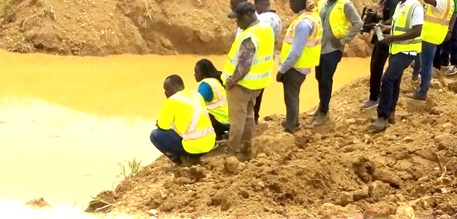
Protecting our polluted water bodies: EPA takes lead in dechemicalisation of affected waterbodies
The Environmental Protection Authority (EPA), as part of its mandate of dealing with polluted waterbodies as a result of illegal mining activities, otherwise known as galamsey throughout the country, has started piloting the cleaning of the waterbodies, normally referred to as dechemicalisation, in the Birim River at Kyebi in the Abuakwa South Municipality of the Eastern Region.
The activity will be replicated in other water bodies, including Pra, Akobra and others.
The project, which was started in the Birim River last Tuesday, is currently being singlehandedly sponsored by the EPA through its Internally Generated Fund (IGF).
Other partners include the Ghana Water Company, the Ghana Standard Authority, the Water Resources Commission, the Ghana Atomic Energy Commission and the CSIR.
Piloting
The pilot project, which uses a technology or method called ironic nano copper (INC), removes turbidity (the brown colour) and heavy metals from the water.
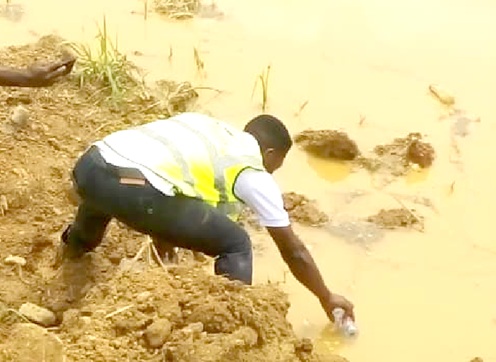
An official of the EPA fetching the water after the dechemicalisation
When tested after 40 minutes to one hour, it proved that the technology was effective, as the water became very clear and clean within that period.
According to the EPA, it costs $200,000 US to dechemicalise one kilometre of any water body, excluding shipping, clearing and other expenses.
Addressing the media after the practical demonstration of the INC application at the Birim River, the Chief Executive Officer (CEO) of the EPA, Professor Nana Ama Brown Klutse, said the project was a call to action by President John Dramani Mahama for the EPA to show the way in the dechemicalisation of the waterbodies for our use as a country.
Dechemicalisation
‘’The conversation started last October on this project. By that time, the EPA was already conducting many investigations by inspecting sites of polluted water bodies across the country using technology to clean them.
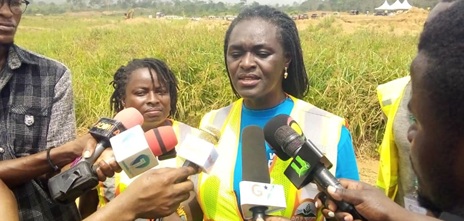
Prof. Nana Ama Brown Klutse, CEO, EPA, speaking to the media
In the same month, the President invited civil society organisations (CSOs) and non-governmental organisations (NGOs) to discuss the galamsey issue. And so, at the meeting, one term that became popular that day was dechemicalisation’’, Prof. Klutse explained.
She said that when the EPA started testing and piloting the new technology, there were arguments about whether the river would regain its biodiversity and whether fish could survive. She explained that from the EPA trials, it proved that fish lives could be sustained, adding ‘’we have seen it with fish, tadpoles, frogs among others’’.
The EPA boss stressed that it took the authority one full year to review the experiments and that, based on the laboratory tests conducted so far, it was clear and the authority was confident that we could clean our waterbodies and obtain clean water for our use, free from pollution.
Prof. Klutse further explained that the EPA’s experiments and trials proved that when clean water joins the main river, it cleans as it moves, adding, ‘’the technology works scientifically in such a way that it consumes every material around it.’’
Game changer
She said the technology was a game-changer if we, as a country, adopted it to clean our waterbodies.
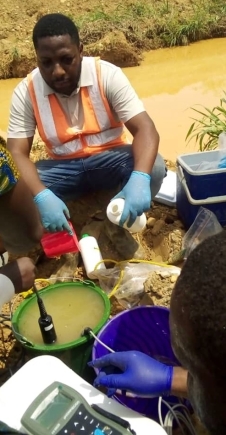
An official of the EPA working on the chemicals for the dechemicalisation of the Birim River
She said EPA officials had visited the factory, seen its production, and how it works, and that settled the question of whether it was possible.
She warned that after dechemicalisation of the main water bodies, EPA would tackle the problem at the source.
‘’We all know that it is through illegal mining activities, which we normally call galamsey that we get our waterbodies polluted and so we have banned mining inside the river bodies.
What we have seen and concluded from our various experiments and trials is that once ironic nano copper is put into even polluted water, it cleans as it moves’’, the EPA CEO stressed.
She seriously appealed to every Ghanaian to support this worthy course to dechemicalise our polluted water bodies in our own interests.
The Abuakwa South Municipal Chief Executive (MCE), Addo-Aikins Junior, said the assembly also started a process to dredge the Birim River from Akeniase down to Kyebi and to move all the miners from the river.
He said the activity would not be easy, as there would be resistance, but added that the assembly would also ensure it carried out its mandate.
The MCE said that since he resumed duty as the political head of the area, his administration had several engagements with the miners about their activities, but added, ‘’nothing is moving them and they continue to do the same thing, and therefore the assembly is left with no option but to apply the law to deal with them seriously.
My interest and that of the assembly is that they dredge the land they have destroyed, and we shall take it up from there’’.
Traditional authorities
The spokesperson for the chiefs, who represented the Okyehene Amoatia Ofori Panyin, Barfour Kyere Koranteng, stated that all the chiefs in the Akyem area were not happy about the activities of the galamseyers, which continued to degrade and pollute their main source of water.
According to the chiefs, even though they are traditional leaders in the area, they would be happy if the government used law enforcement bodies to decisively address the situation.
All EPA partners who spoke to the media were in support of the project and appealed for support from all and sundry to ensure its sustainability, since we do not have other means of getting water if all our river bodies are destroyed.
