
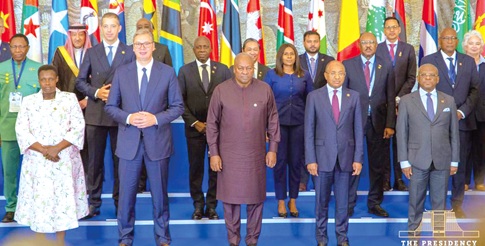
President John Dramani Mahama has called on member states of the Non-Aligned Movement (NAM) to prioritise resource sovereignty as the anchor of their development agenda.
He cautioned against a global order that kept the Global South as exporters of raw materials and importers of finished goods.
President Mahama was speaking at the High-Level Commemorative Meeting marking the 65th anniversary of the first Conference of Heads of State or Government of Non-Aligned Countries in Belgrade, Serbia, yesterday.
He affirmed that political independence was more meaningful when accompanied by the economic capacity to pursue national priorities; hence, the need for member states to pursue resource sovereignty in their development agenda.
"We cannot accept a global order in which countries of the Global South remain exporters of raw material and importers of finished goods, while our people bear the environmental and social costs of extraction," President Mahama stressed.
Context
The President’s call for resource sovereignty reflects Ghana’s policy shift from exporting raw materials to value addition and retention.
For instance, last year, the government established the Ghana Gold Board (GoldBod) as the sole buyer and exporter of artisanal gold to curb smuggling and capture value within the country.
GoldBod bought over 100 tonnes worth more than $10 billion between January 2025 and May 2026 and last month secured 30 per cent of large-scale output to be sold locally, refined domestically and banked as reserves under the Ghana Accelerated National Reserve Accumulation Programme (GANRAP).
The government has also stated that no raw mineral ore will leave Ghana by 2030, including manganese, bauxite and iron ore.
Cabinet, earlier this year, also ordered a minimum of 50 per cent local processing of those minerals, as well as cocoa beans, from next year, among other strategic plans to ensure resource sovereignty.
NAM is the world's second-largest state grouping after the United Nations (UN), formed in 1961 in Belgrade by leaders, including Ghana’s first President, Dr Kwame Nkrumah; President of Yugoslavia, Josip Broz Tito; Prime Minister of India, Jawaharlal Nehru; President of Egypt, Gamal Abdel Nasser and President of Indonesia, Sukarno.
It has over 100 members from Africa, Asia-Pacific, Latin America, the Caribbean, Europe, as well as other observer organisations. It was birthed at the height of the Cold War and founded on the principle of "positive neutrality”.
Resisting power bloc pressures
President Mahama also charged the NAM to resist the pressures of power bloc politics in an increasingly fragmented and multipolar world and preserve its strategic autonomy for common development.
He said that, amid increasing geopolitical developments, Non-Aligned countries must be neither silent spectators nor instruments of competing geopolitical interests.
“Rather, we must be an independent, collective voice for peace, dialogue, disarmament, development, and justice, capable of influencing the international system and advancing a more representative and equitable global order," he added.
Quoting Dr Nkrumah, President Mahama said NAM's creed of positive neutrality must not be passive.
"As he aptly stated, ‘our politics of positive neutrality is not passive or neutral politics.’
This is affirmative politics based on our firm belief in positive action. It is this spirit of positive action that must continue to guide our non-aligned movement," he said.
However, President Mahama said non-alignment must never be understood as neutrality in the face of injustice, conflict or the erosion of international law.
The movement, though born during the Cold War, according to the President, remained highly relevant today, having evolved to address contemporary economic, political and developmental challenges and to promote a fairer international economic order.
"With its broad membership, NAM provides developing countries with a strong collective voice in the multilateral system.
It can further strengthen South-South cooperation and advance common positions on development, finance, trade, climate change, debt, technology, and the reform of the global financial architecture," President Mahama said.
Looking ahead, he said, NAM must also build on its historical legacy, while adapting to a changing world, adding that it must move from declarations to actions.
