
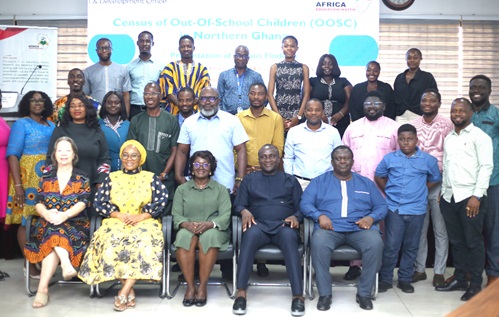
Study reveals alarming school boys dropout rate in Northern Ghana
A study has revealed that five out of 10 boys between the ages of four and 17, who are supposed to be in school, are out of the classroom in 20 districts across the five regions in northern Ghana.
About 3,536 boys across 20 districts are dropping out of school, significantly higher rates than girls in the same communities, reversing the trend observed where girls were more likely to leave school due to early marriage and socio-cultural barriers.
If this trend continues, the country risks losing a generation of young men to illiteracy, poverty and social vices, including gambling, hazardous labour and illegal mining activities.
The Executive Director of Africa Education Watch, Kofi Asare, said the data underscored a troubling trend where children who started school at lower primary levels were increasingly unable to remain enrolled as they advanced through upper primary and junior high.
He said the rising dropout rates were driven by shortage of teachers, poverty, migration pressures, hazardous labour and the growing lure of sports betting and galamsey activities among boys.
He said urgent measures were needed to retain children in school and protect the gains made in girls’ education.
Trend, threat
Speaking at a stakeholders meeting convened by Eduwatch, Mr Asare said enrolment at the lower primary level was encouraging but as children grew older, particularly from ages 12 to 17, many were lost.
“Our census across 20 districts in Northern Ghana shows that in some communities, over 50 per cent of boys in this age group are out of school, while girls’ dropout rate remain lower.
This is a sharp reversal of the usual trend where girls are more vulnerable to leaving school due to early marriage or socio-cultural barriers,” he said.
He explained that the dropout trend was linked to several interconnected factors. “In many schools, we have severe teacher shortages. Some schools have only one teacher, while others have none at all. Even when children are re-enrolled through remedial or accelerated learning programmes, the lack of teachers and learning resources often force them back into the community,” he said.
Mr Asare further highlighted poverty, migration and hazardous labour as major contributors to children leaving school. “Families depend on children for farm labour, household chores or other income-generating activities. In such contexts, school becomes secondary, and many children, especially boys, end up out of school permanently,” he said.
He also raised concern about the growing attraction of boys to sports betting, lottery and illegal mining (galamsey).
“These activities present a ‘get rich quick’ perception and are pulling more boys out of school than girls. Communities need to enforce bylaws and protective measures to keep children away from betting centers and galamsey sites,” he emphasised.
Social Support
Mr Asare stressed the importance of extending social support programmes, particularly the Ghana School Feeding Programme, to junior high schools.
“Children in primary school benefit from free hot meals, which encourages attendance. But when they transition to junior high, the meal support stops.
Families in deprived areas struggle to provide lunch daily, and children drop out,” he said.
He said that millions of cedis had been invested in enrolling out-of-school children through complementary programmes, however, the investment would not be beneficial if the progression was not sustained.
“These investments risk being lost if the formal school environment is not prepared, schools must have teachers, learning resources and systems that retain children once they enter the classroom.
“Our investments in complementary education programmes, accelerated learning and teacher recruitment will only succeed if the school environment is prepared to receive these children and retain them.
It is our shared responsibility to ensure that all children, boys and girls, remain in school and are given the opportunity to learn and thrive,” he said.
Responsibility
An Eduwatch Board Member, Dorothy Konadu, said the study provided critical evidence for shaping Ghana’s education policies.
“The children identified in this census are not statistics.
They are Ghanaian learners whose futures depend on the decisions we make today,” she said.
She explained that after four years of implementing Out-of-School remedial interventions under the current Education Sector Medium-Term Plan (2022–2025), it is essential to assess progress and generate insights for the next Medium-Term Plan (2026–2029).
“Although national discourse often focuses on girls’ education, our findings show that boys, particularly in districts such as Chereponi, Nanumba South, Tatale Sanguli and Bawku West, are increasingly at risk due to migration, hazardous work and socioeconomic pressures.
This calls for targeted, context-specific strategies for boys as well as continued support to address factors keeping girls out of school,” she said.
