
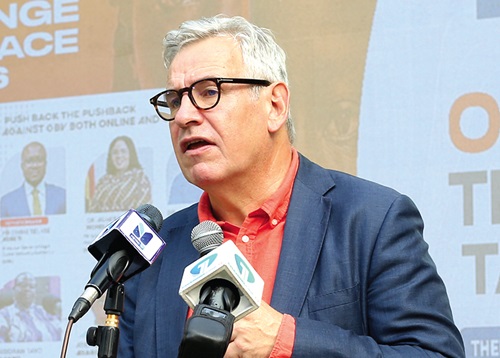
EU partners government, Oxfam to mark 16 Days of Activism
The European Union (EU), in partnership with the Government of Ghana and Oxfam, has held its maiden “Orange Terrace Talk”, a space to reflect and strengthen collective resolve to end all forms of gender-based violence to mark this year’s 16 Days of Activism Against Sexual and Gender-Based Violence.
The event, which was held in Accra, was organised on the theme “Push back the pushback against gender equality: online and offline.”
It brought together government officials, the diplomatic community, youth groups, cybersecurity actors, and development partners to deliberate on the rising cases of online and offline gender-based violence in the country.
At the event, the European Union Ambassador to Ghana, Rune Skinnebach, said progress made in gender equality over the decades had been threatened and, in some areas, reversed, making coordinated action more important than ever.
He said the country had witnessed increases in gender-based violence, teenage pregnancies, and sexual harassment in schools and universities, as well as a rise in online harassment.
“2025 saw cases of sexual harassment and assault at Ghanaian schools and universities, and a rise in both online and physical harassment and threats,” he said.
Mr Skinnebach described the rise in non-consensual sharing of intimate images and manipulated deep-fake content as “deeply worrisome.”
He said the EU had committed over EUR 8 million in the last five years through grants to civil society to address GBV and strengthen digital safety.
“The EU will do its share to advance digital safety in Ghana, strengthening gender-responsive policies and reinforcing survivor-centred systems,” he added.
The Minister for Gender, Children, and Social Protection, Dr Agnes Naa Momo Lartey, said the government had implemented a number of legal frameworks to ensure the protection of women, girls, and vulnerable persons.
These include the Affirmative Action Law, the Domestic Violence Act (Act 732), the Children’s Act (Act 560), the Human Trafficking Act (Act 694), and the Juvenile Justice Act (Act 653).
However, she said new forms of abuse, particularly those facilitated by technology, demanded updated laws and stronger punishments.
“Evolving forms of GBV, online harassment, technology-facilitated abuse, and workplace harassment require expanded definitions and more punishment to serve as a deterrent to others,” she said.
Dr Lartey said cultural norms that normalised abuse continued to hinder justice.
Online abuse
She said online safety must be treated as part of overall well-being, insisting that digital harm often resulted in trauma and exclusion.

Invited guests and participants in the event
The Country Director of Oxfam in Ghana, Mohammed-Anwar Sadat Adam, said online gender-based violence had evolved continuously and had become closely connected to offline abuse.
He referenced the EU–Oxfam ENOUGH Project, describing it as a major initiative that expanded access to reporting systems and justice through digital tools.
“The ENOUGH Project underscored a critical reality: online gender-based violence is rising, rapidly evolving, and deeply connected to offline abuse,” he said.
