
From lab to national Stage: CSIR-SARI Scientist recognised for major scientific breakthroughs
When Dr Jerry Asalma Nboyine first walked into the corridors of the Council for Scientific and Industrial Research–Savanna Agricultural Research Institute (CSIR-SARI) at Nyankpala as a young research scientist 14 years ago, he was determined to use science to solve real problems facing farmers in Northern Ghana.
While pests were destroying crops, particularly cowpea, unpredictable weather was also threatening crop production. Beyond the laboratories, he saw an opportunity to make a lasting impact on agriculture in the area.
At the time, cowpea, which is one of the most important staple crops, was failing farmers year after year due to insect infestation and climate change.
To control the insects, farmers resorted to heavy use of insecticides, which was silently endangering both human health and the environment.
Breakthrough
In 2015, Dr Nboyine and a team of researchers at CSIR–SARI undertook a research project to develop the first genetically modified pod borer-resistant cowpea.
They modified the cowpea genotype IT-86D-1010 with the cry1Ab gene, which produces a protein that kills the pod borer but remains safe for human and livestock consumption.
The team conducted laboratory work, confined field trials, food safety tests and environmental assessments.
After rigorous assessment, the National Biosafety Authority approved the GM cowpea for environmental release in 2022.
The material was then crossed with the popular local variety, such as Songotra, producing Songotra-T.
Field trials over two successive seasons in 15 locations across northern Ghana confirmed its effectiveness, allowing farmers to reduce insecticide applications from eight sprays to just two, while doubling yields to 2,000 kg per hectare.
Since its release in July 2024, there has been a high demand for seeds of the Songotra-T variety among farmers. Some farmers who have already tried the variety are reporting healthier crops, reduced labour and chemical costs, and significantly higher incomes with estimated returns at about 500 per cent, compared with 250 per cent for conventional varieties.
Beyond GM Cowpea
Beyond the development of the GM cowpea, Dr Nboyine is a leading expert in climate-resilient pest management, promoting habitat manipulation, biological control and integrated pest strategies.
Through collaborative research at CSIR-SARI, his work has contributed to the release of over eight cowpea varieties, four sorghum varieties, three sweet potato varieties, and two groundnut varieties, significantly enhancing crop productivity and resilience.
Each year, he leads over ten farmer field schools and field days, ensuring that new technologies reach the communities that need them most.
Also, from January 2021 to December 2022, he served as Team Lead of the Northern Region Farming Systems Research Group (NR-FSRG). He also now heads the Crop Protection and Post-harvest Programme at CSIR-SARI to champion innovations that strengthen food security and reduce post-harvest losses.
Honour
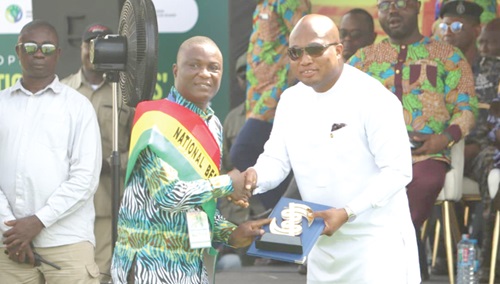
In recognition of his hard work and research breakthrough, the Research Scientist was honoured as the National Best Agriculture Researcher at the 41st National Farmers Day celebration in Ho last Friday.
For his prize, he received a double-door refrigerator, a laptop, two motorised sprayers, two knapsack sprayers, two machetes, two pairs of Wellington boots and assorted pesticides.
A citation read for him described the Research Scientist as an innovative and self-motivated person committed to turning research into solutions for farmers' everyday challenges.
Gratitude
Commenting on the award, Dr Nboyine thanked the government and the Ministry of Food and Agriculture for recognising his contribution towards the promotion of research and agriculture in the country.
He also thanked the management of CSIR-SARI and his colleagues for their continued support and motivation throughout his research journey.
He said the award was not just an honour, but also a challenge for him to work even harder to develop innovations that directly improve the lives of farmers and strengthen food security in the country.
Writer’s email:
