
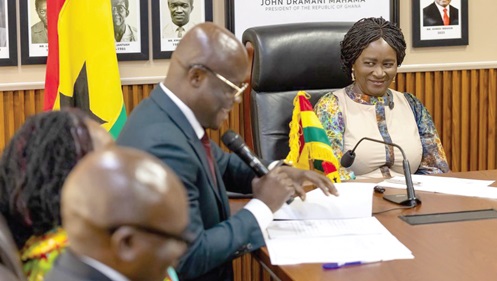
Support underperforming MMDAs to improve - Vice-President charges Local Govt Ministry
The Vice-President, Professor Naana Jane Opoku-Agyemang, has urged the Ministry of Local Government, Chieftaincy and Religious Affairs to support underperforming assemblies to improve, adding that national progress depends on the success of all parts of the system.
Speaking during a working engagement with management and staff of the ministry, Prof. Opoku-Agyemang emphasised the need for inclusive performance improvement, stressing that attention must be given to high performers and those who fall short.
“As a teacher, I am interested in both those who have passed and those who have not because I would like to believe that they are capable of passing. Maybe some things went wrong, so let's identify them and let's encourage them to do more because the more they succeed, the more Ghana succeeds,” she added.
She assured the ministry that the government was ready to provide the necessary backing to enable the ministry to deliver on its mandate.
“We are here to encourage you, appreciate your work and let you know that we have your back. If you need support, we are there to give it to you, and we are also here to collaborate with you,” she said.
She commended the Ministry for its central role in the country’s governance, describing the sector as being “at the heart of the things that we do” as the government deepens or pushes its decentralisation agenda.
The Vice-President said local governance, chieftaincy and religious affairs directly touch the daily lives of Ghanaians, making the ministry’s work critical to peace, development and national cohesion.
She stressed the need to respect and strengthen all forms of the country’s governance system. “Chieftaincy, we know we have different types of governance. We have our traditional ones, the modern ones. And they are all very important”.
She added that religious coexistence also plays a key role in sustaining peace in the country.
The Vice-President emphasised that peace and stability could only be achieved when these “branches of social governance” are taken seriously and managed with care.
Professor Opoku-Agyemang also highlighted the need for accountability in the use of public funds.
She welcomed the ministry’s commitment to ensuring that disbursed funds are properly accounted for and effectively used.
Visit
The visit was part of the Vice-President’s efforts to support various ministries, departments and agencies in the country.
The engagement with key ministries is to enable the government to better understand their work, challenges and support needs, particularly those led by women, in line with efforts to promote inclusive governance.
She had earlier visited the Ministries of Education, Health and Gender, Children and Social Protection.
Prof. Opoku-Agyemang was accompanied by the Chief of Staff in her office, Alex Percival Segbefia, and other staff.
She was received by the Minister of Local Government, Chieftaincy and Religious Affairs, Ahmed Ibrahim, together with management, staff, and heads of agencies under the ministry.
Achievements
Mr Ibrahim said one of its flagship achievements was the finalisation of the design for a modern 24-hour economy market, which was to be adopted and constructed by all 261 Metropolitan, Municipal and District Assemblies (MMDAs).
He explained that consultants have been engaged, orientation workshops have been held for Regional Ministers and MMDAs, and training is currently ongoing at the regional level.
The minister described the appointment of government appointees and Metropolitan, Municipal and District Chief Executives (MMDCEs) as one of the fastest in Ghana’s history, with all 30 per cent government appointees sworn into office across the 261 MMDAs within record time.
On legislative reforms, Mr Ibrahim said the Ministry, in collaboration with the Inter-Ministerial Coordinating Committee on Decentralisation, had established a framework to review the Local Governance Act, 2016 (Act 936).
He added that the timely release of the District Assemblies Common Fund was the first time in Ghana’s history that funds had been released to assemblies within one month after the end of each quarter, covering the first, second and third quarters of 2025.
Mr Ahmed said that the ministry had reintroduced formal guidelines for the utilisation of the Common Fund, after several years without such directives, to prevent misuse and ensure accountability across all 261 assemblies.
The minister announced the successful conduct of the ninth cycle of the District Assembly Performance Assessment Tool (D-PAT), which stalled under the previous administration.
He said 118 assemblies passed the assessment, qualifying them to share approximately GH¢1.2 billion in performance grants, in addition to their regular Common Fund allocations.
To empower assembly members, Mr Ibrahim disclosed that the ministry facilitated the release of GH¢100 million in allowances for assembly members in 2025.
Regarding policy reforms, he stated that the ministry had conducted nationwide consultations to review the National Decentralisation Policy and Strategy, with a Cabinet paper already submitted and the final policy expected to be presented for approval in due course.
Mr Ibrahim further announced the finalisation and validation of the Environmental Sanitation Policy and Strategy Action Plan, as well as the review of the National Urban Policy and the National Slum Upgrading and Prevention Strategy, all of which are aligned with the government’s new development vision.
