
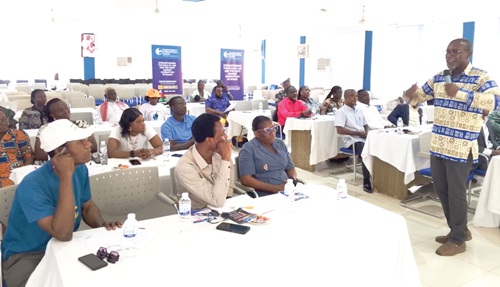
Tackling gender-based corruption: 135 Journalists, CSOs in 3 regions receive training
One hundred and thirty-five media practitioners and Civil Society Organisations (CSOs) from the Bono, Bono East and Ahafo regions have undergone training in anti-corruption reporting and the gender dimension of corruption.
Selected from nine districts in the three regions, the training is to help them identify, report and speak against gender-related corruption, especially sextortion.
The beneficiary districts are the Sunyani West Municipality, Wenchi Municipality and Dormaa West District in the Bono Region; Techiman Municipality, Techiman North District and Kintampo South District in the Bono East Region and Tano North Municipality, Asutifi North District and Asunafo South District in the Ahafo Region.
Also aimed at increasing advocacy at the local level, the initiative is supported by the EU through GIZ under the Participation, Accountability, and Integrity for a Resilient Democracy (PAIReD) project.
Training
The participants from the Bono and Ahafo regions were trained in Sunyani, while beneficiaries from the Bono East Region were trained at Techiman.
They were taken through different forms of corruption, such as bribery, fraud, embezzlement, nepotism, facilitation payment, illegal contributions, sextortion, gender and other corruption-related issues.
The training forms part of Transparency International’s (TI-Ghana) plans to train 720 CSOs and media practitioners in 60 districts across the country.
TI-Ghana said it initiated the training because of the findings of the 2016 Afrobarometer survey, which reported that citizens supported the idea of collective involvement in the fight against corruption.
Impediment
At the training at Abesim near Sunyani in the Bono Region last Wednesday, the Fundraising Manager at TI-Ghana, Michael Kwame Boadi, said corruption remained one of the major impediments to the country’s sustainable development, democratic consolidation and equitable social progress.
He underscored the need for CSOs and media persons to understand corruption to effectively investigate such cases or demand accountability.
He explained that through awareness creation and investigative reporting, the media could spotlight cases and trends, while CSOs could mobilise communities to demand accountability.
Mr Boadi expressed concern over the increasing number of corruption cases in the country, while the country's effort to fight corruption was decreasing.
He said that despite the laws and establishment of multiple anti-corruption institutions, including the Office of the Special Prosecutor (OSP), the country had not been able to fight against corruption.
Mr Boadi explained that women and the youth suffered more when corruption occurred.
Empower
The PAIReD Project Coordinator at TI-Ghana, Aning Bonsu Osei, said the training was intended to empower CSOs and media actors with the right knowledge and tools to expose and challenge sextortion.
He explained that media practitioners and CSOs were key agents of accountability.
Mr Osei said under the programme, 200,000 citizens would also be empowered across the country to demand accountability at the local level.
He said they were implementing the project in collaboration with the Ghana Anti-Corruption Coalition (GACC), the National Commission for Civic Education (NCCE), the Commission for Human Rights and Administrative Justice (CHRAJ) and the Centre for Democratic Development (CDD-Ghana).
Participants
Participants who spoke to the Daily Graphic said the training was useful and commended TI-Ghana for the initiative.
The Dormaa West District Coordinating Director, Esther Abaching, said the training had helped to improve her knowledge on corruption-related issues.
She added that she had identified some of the reporting mechanisms and the channels to report corrupt practices when the need arose.
Mrs Abaching said she would use the knowledge to fight corruption and school others to advocate against corruption.
The objective of the initiative is to build the capacity of the participants on the concept, forms, and impacts of Gender-related corruption and enhance their knowledge of relevant legal and policy frameworks for addressing sextortion.
It's also aimed at promoting collaboration between CSOs, media and state institutions for coordinated responses and referrals.
The training is expected to increase awareness and understanding of Gender-related corruption among CSOs and media actors and strengthen collaboration between local anti-corruption networks and gender advocacy groups.
Writer's email:
