
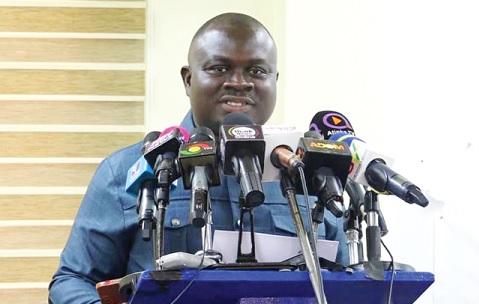
The Ghana Journalists Association (GJA) has given the Ghana National Fire Service (GNFS) a 14-day ultimatum to release the findings of its investigation into the assault on Class FM reporter Samuel Addo, warning that failure to do so could result in sanctions, including blacklisting.
The association also declared the Bawku conflict area an early warning zone for press safety, citing reports of death threats and sustained intimidation against journalists covering the conflict in the Upper East Region.
The GJA President, Mr Albert Dwumfour, announced the decisions at a press conference held at the Ghana International Press Centre in Accra on Wednesday, January 28, 2026, where he also briefed the public on a series of recent attacks on journalists across the country.
“We are giving the Fire Service a 14-day ultimatum to act on this request. If they fail to do so, we will take steps against them, including blacklisting,” Mr Dwumfour said.
He said the association was deeply dissatisfied with what it described as the persistent silence from the leadership of the Fire Service, despite the interdiction of officers implicated in the assault at Kasoa, which was ordered by President John Dramani Mahama.
According to Mr Dwumfour, the failure of the service to update the public on the status of its internal investigations raised serious concerns, adding that continued silence would be interpreted as an attempt to shield wrongdoing.
The association also reiterated its call for the removal of the Fire Service’s Public Relations Officer, saying its engagements with him had demonstrated that he was not fit to manage communication for the service on the matter.
Turning to the Bawku situation, Mr Dwumfour said journalists covering the conflict had been openly labelled as enemies and subjected to coordinated online harassment.
He said threats had been issued through social media posts, voice notes and other digital platforms, creating an increasingly hostile environment for media practitioners.
He disclosed that the GJA Chairman for the Upper East Region, Mr Albert Sore, was among journalists who had received death threats linked directly to their professional work in the conflict area.
“The Association formally designates the Bawku conflict area as an early warning zone for press safety. This calls for increased vigilance, security presence and constant engagement with journalists on the ground,” Mr Dwumfour said.
He warned that any attack on a journalist in the Upper East Region, particularly in cases where threats had already been reported, would be regarded as a failure of protection and would trigger sustained national and international action until accountability was achieved.
The association said it had formally petitioned the Inspector-General of Police to intervene and called for police protection for affected journalists, expedited investigations and the arrest and prosecution of individuals issuing threats.
The press conference also addressed recent assaults on journalists, including an attack on UTV and Peace FM Eastern Regional Correspondent, Mr Michael Akrofi, by a police officer at Kukurantumi on January 8.
According to the GJA, the officer strangled Mr Akrofi on three occasions while he was covering a protest by farmers over the destruction of crops by Fulani herdsmen. The journalist later complained of pain in his neck, back and waist and sought medical attention.
Mr Dwumfour further reported an assault on Media General’s North East Regional Correspondent, Mr Solomon Kwame Kanaluwe, by military personnel in Walewale on January 26.
He said Mr Kanaluwe was beaten with sticks and canes after parking his motorcycle near a roadside shop. His mobile phone was seized, and pictures and messages were deleted, even after he identified himself as a journalist.
“Even after Mr Kanaluwe identified himself as a journalist, the assault reportedly continued, with the soldiers stating they did not care about his profession,” Mr Dwumfour said.
The association stressed that there were clear red lines that must not be crossed, stating that journalists must not be assaulted while performing lawful duties, security agencies must not seize equipment or delete content, and internal disciplinary measures alone were insufficient where criminal conduct was alleged.
Mr Dwumfour warned that silence by institutions following attacks on journalists would be regarded as tolerance for wrongdoing.
He also appealed to President Mahama to convene a meeting between security chiefs and the leadership of the GJA, which he said had earlier been promised, noting that recent incidents involving security agencies made such engagement urgent.
“Mr President, this is the right time for that meeting,” Mr Dwumfour said, adding that the President, as a member of the association, had consistently shown interest in matters affecting journalists.
The GJA said it would pursue both local and international action against institutions that fail to respond adequately to attacks on media practitioners.
