
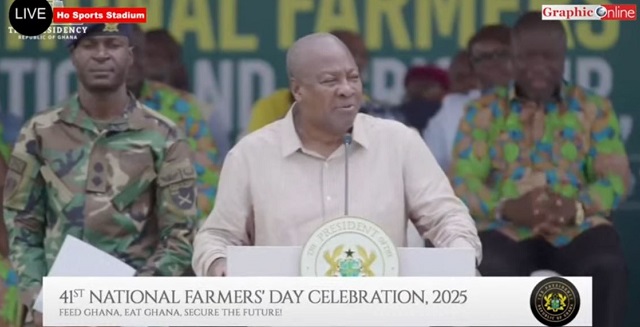
President John Dramani Mahama has announced that government will soon launch a national School Agriculture Programme, which will require all secondary schools and tertiary institutions to operate school farms.
He said the initiative will help students produce their own vegetables, livestock and poultry while strengthening national food security.
Speaking during the 41st National Farmers’ Day celebration in Ho on Friday, December 5, President Mahama explained that a National School Agriculture Coordinator has already been appointed to oversee the rollout.
He said by engaging young people directly in food production, he noted, the programme will build agricultural interest, reduce Ghana’s food import bill, and ensure schools rely more on locally grown produce.
"I will soon launch a school agriculture program. We are asking all secondary schools and tertiary education institutions to have a school farm
where they can produce their own chicken, they can produce their own livestock, goats, small ruminants, goats, sheep and big ruminants like cattle," he said.
"But also produce their own vegetables, their tomatoes, their peppers, their okra and all the other vegetables that they eat and so we have appointed a national school agriculture coordinator and soon we shall launch that program. And I believe it will also contribute to Ghana's food security."
The President highlighted broader measures to boost agriculture, including irrigation expansion using solar water pumps, cheaper credit targeted at farmers, mandatory local procurement for school feeding (especially for rice, maize and poultry), and the promotion of scientific innovations from local research institutions.
He emphasised that food security is central to national development and encouraged all citizens , including professionals — to consider farming as an additional source of income.
President Mahama further emphasized that agriculture is a profitable venture, revealing that he himself farms and urging government officials and citizens to acquire land and invest in crops such as oil palm to boost their incomes.
He encouraged widespread participation in farming to supplement earnings and strengthen national production.
He also commended the US government for lifting tariffs on Ghanaian agricultural exports—including cocoa, avocado, oranges, pepper, onions, and yams—creating a zero-tariff opportunity in the US market.
With Ghana’s current agricultural export volume to the U.S. at about $100 million, he urged farmers to take advantage of the expanded market potential to increase exports and earn more income.
