
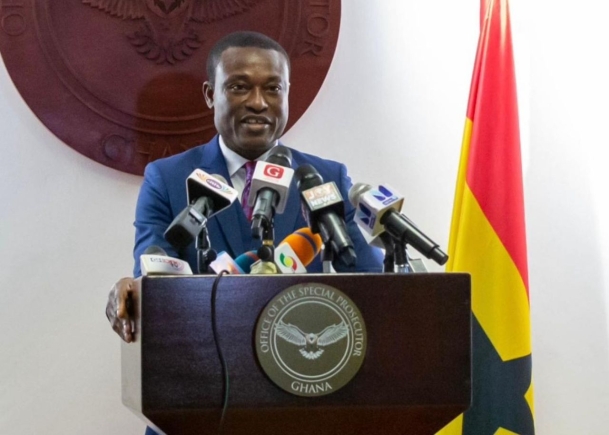
OSP probes GH¢345 million port fees arrangement with private firm, directs Ghana Health Service to explain
The Office of the Special Prosecutor has directed the Ghana Health Service to submit an Integrity Plan by March 31, 2026, after findings showed that a private company collected disinfection fees at the country’s ports and kept the funds in its private accounts.
The directive follows a corruption risk assessment completed last month, which found that LCB Worldwide Ghana Limited retained revenues meant for the state without effective oversight.
In its July 2025 to December 31, 2025 Half Yearly Report, the Office of the Special Prosecutor stated that the arrangement cost the state an estimated GH¢345 million. This figure includes GH¢25 million in Value Added Tax collected from port users but not paid to the government.
The Special Prosecutor, Mr Kissi Agyebeng, said the assessment showed that LCB was granted an exclusive nationwide monopoly to carry out disinfection services at all ports of entry. Under the arrangement, the company charged importers and exporters directly, kept the proceeds in its own accounts, and determined how much to transfer to state agencies.
“The corruption risk assessment concluded that the arrangement presents material corruption vulnerabilities across legal authority, procurement, fee setting, financial flows, institutional oversight, competition, transparency and public health outcomes,” Mr Agyebeng said in the report.
He described the situation as one that posed an “immense systemic corruption risk” and called for urgent corrective steps.
As part of immediate measures, the Office of the Special Prosecutor has ordered the suspension of all payments to LCB pending a forensic audit. It also directed that the company stop holding and retaining fees and other revenues in its private accounts.
The Ghana Revenue Authority has been tasked to exercise oversight over LCB’s tax obligations and recover any unpaid taxes.
The Ghana Health Service has been given until March 31, 2026, to submit its Integrity Plan outlining corrective actions and a reorganisation of the ports disinfection programme to prevent abuse and improve openness and accountability.
The report explained that the business model allowed LCB to charge every importer and exporter at the ports, keep all receipts in its own accounts, make partial payments to state institutions at its discretion, and submit operational reports without independent checks.
The Office of the Special Prosecutor said the arrangement effectively placed control of public revenue in the hands of a foreign private company, without a clear system for oversight or accountability.
According to the OSP, the intervention is estimated to have saved the state about GH¢345 million. This includes GH¢120 million in avoided costs, GH¢25 million in VAT and statutory revenue preserved or expected to be recovered, and GH¢200 million in future losses averted.
The report stated that any future arrangement must be regularised through lawful and transparent processes, with strong financial, technical and governance controls.
The July 2025 to December 31, 2025 Half Yearly Report of the OSP was released on Thursday, January 29, 2026.
Attached below is a copy of the full report
GHANA HEALTH SERVICES AND LCB WORLDWIDE GHANA LIMITED
In December 2025, the Office concluded corruption-risk assessment of disinfection services at the national ports of entry
between Ghana Health Services and LCB Worldwide Ghana Limited (LCB).
The arrangement grants LCB an exclusive nationwide monopoly to conduct disinfection services and to collect charges directly
from importers and exporters. The model also permits LCB to retain revenues in its private accounts, make partial disbursements to government agencies, and report on its operations without independent verification.
The OSP corruption assessment concluded that the arrangement presents material corruption vulnerabilities across legal authority,
procurement, fee imposition, financial flows, institutional oversight, competition, transparency, and public health efficacy.
Therefore, the OSP classified the arrangement as attended by immense systemic corruption risk which requires immediate
corrective steps for the mitigation of corruption and corruption related vulnerabilities. Further, any future arrangement must be
regularised through a lawful, transparent framework with rigorous financial, technical, and governance controls.
Consequently, the OSP directed, inter alia, the immediate suspension of all disbursements pending a forensic audit;
immediate cessation of private custody and retention of fees and revenue; and the preservation and recovery of taxes and Ghana
Revenue Authority oversight in respect of tax obligations.
The OSP further directed Ghana Health Service to submit an Integrity Plan to the Office, on or before 31 March 2026, detailing
corrective steps taken and systematic re-organisation and be undertaken to prevent corruption, assure transparency and
accountability.
The intervention by the OSP has saved the Republic an estimated sum of Three Hundred and Forty-Five Million Cedis
(GHC345,000,000.00) with the breakdown as follows꞉
Cost Avoidance = GH₵ 120,000,000.00
VAT & Statutory Revenue (Preserved/Recovered) = GH₵ 25,000,000.00
Prevented Future Exposure = Gh₵ 200,000,000.00
