Journalists urged to prioritise accuracy over speed
An Associate Professor of Communication at the University of Ghana, Prof. Abena Yeboah-Banin, has called on journalists to avoid rushing to break the news, thereby sacrificing accuracy for speed.
She also called on journalists to avoid overgeneralisation, the use of misleading graphs and visuals, sensationalisation, and presenting preliminary findings as conclusive data.
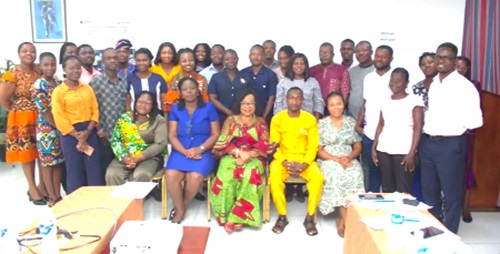
Prof. Yeboah-Banin made the call at a two-day media capacity-building workshop on urban health reporting in Accra from July 8 to 9, organised by the University of Ghana-based
CHORUS Project in collaboration with Women, Media and Change (WOMEC).
The CHORUS Project is focused on improving urban health and is funded by the UK Foreign, Commonwealth & Development Office (FCDO).
In Ghana, it is led by the School of Public Health at the University of Ghana, Legon.
The initiative brought together journalists, researchers, communication experts and public health professionals to strengthen the media’s role in bridging the gap between scientific research and public understanding, especially in underserved urban communities, to enhance the journalists’ ability to report on health and science issues using data.
Demystify research findings
Prof. Yeboah-Banin urged journalists to take a more proactive role in demystifying scientific research findings for the general public, particularly on urban health issues.
According to her, the persistent disconnect between researchers and the media continues to undermine the real-world impact of critical scientific data, saying that when such data is effectively used, it could shape public understanding, influence behaviour and improve health outcomes.
Prof. Yeboah-Banin called on journalists to simplify complex scientific concepts and findings to make them easy to understand.
She also called on them to serve as a bridge to connect academics, researchers and the masses.
She further called on science journalists to build a pool of science experts who can serve as their go-to experts on health and science issues, as well as validation voices for their stories.
She urged the journalists to concentrate on the traditional 5Ws and H, seek simplified explanations for their reporting, and avoid technical jargon by using everyday examples to relate to lived experiences.
She, however, said that although statistics played an essential role in providing evidence and brought credibility to the claims of scientists and researchers, it was not a language of the masses.
Therefore, they should focus on translating statistics for the masses rather than merely repeating them.
“The power of scientific research lies not only in discovery but in dissemination,” Prof. Yeboah-Banin said, adding that if findings remained within the confines of academia and are not shared in a way the public could understand, then their potential to transform lives, especially in the area of urban health, would be defeated.
Catalyst for change
The Director, Women Media and Change, Dr Charity Binka, on her part, called on journalists to build stronger relationships with scientists, research institutions and policymakers, saying such collaborations would enhance the accuracy and credibility of health reporting, particularly on urban issues.
She said that only through such collaboration would the masses fully benefit from scientific research on their health needs, as she believed the media acted as a catalyst for change.
The Head of the Capacity Strengthening Support Office at CHORUS, Delali Kumapley, highlighted the media’s unique role in spotlighting health disparities in urban poor communities, saying urban health was at the heart of sustainable development.
She said CHORUS Ghana’s mission was centred on connecting communities, local authorities and healthcare providers to promote health and preventative services in impoverished urban areas.
Writer’s email: