
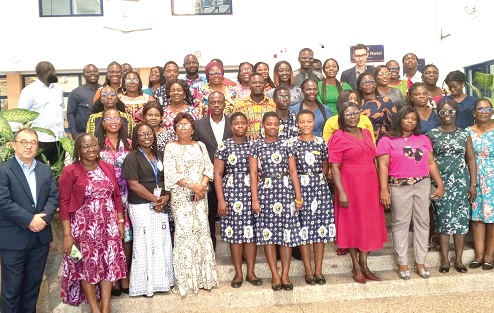
New study reveals alarming mental distress among health workers
A national policy dialogue on mental health has called for the urgent integration of mental health screening and support for pregnant women, new mothers and frontline health workers into routine primary healthcare services.
The call was born out of the RESPONSE Research Project led by the London School of Hygiene & Tropical Medicine (LSHTM), in collaboration with the Ghana Health Service (GHS) Research and Development Division (GHS RDD) and other partners with funding from the UK Medical Research Council, Foreign Commonwealth & Development Office (FCDO) and Wellcome Trust.
Findings
Findings were presented from 42 months of research, including a six-month pilot implementation in six primary health facilities in Prampram-Ningo and Shai-Osudoku districts in the Greater Accra Region of interventions to support maternal and frontline health worker mental health.
The dissemination meeting brought together stakeholders from the GHS, Mental Health Authority and women with lived experience, as well as the Ghana Education Service (GES) and adolescents.
Presenting some of the findings of the research, a Co-Principal Investigator and Ghana Team Lead of the project, Professor Irene Agyepong, revealed that 28 per cent of over 2,000 antenatal and postnatal women screened, using the WHO Self-Reporting Questionnaire (SRQ-20), showed signs of mental health distress.
“Traditionally, we focus only on postpartum depression, but our data shows the problem often starts during pregnancy,” Prof. Agyepong said.
“Maternal and health worker mental health is not a luxury—it is foundational to achieving universal health coverage and the Sustainable Development Goals.
“Today’s evidence shows we already have some simple, feasible and acceptable solutions. The question is no longer ‘if’ but ‘how quickly and how well’ we act,” she said, among other things.
Interventions
Two innovative interventions co-designed with health workers, communities, and district officials were piloted over six months and formatively evaluated as part of the project.
A Principal Investigator of the project, Prof. Tolib Mirzoev, highlighted some recommendations, saying first and foremost, health systems responsiveness was a critical aspect of health systems performance.
“Prioritisation of health systems’ responsiveness to the needs of health staff and the wider societal drivers of health systems responsiveness are really critical.
For example, very often, mental health is stigmatised both for patients and staff,” he added.
Call
In his remarks, the Director of the Dodowa Health Research Centre of the Research and Development Division of the GHS, Dr Frank Atuguba, urged the Ministry of Health and GHS to revise national reproductive health guidelines to include routine maternal mental health screening and establish clear policy and budgetary support for frontline health worker well-being.
A researcher on the project, Dr Bertha Garshong, emphasised that adolescent mothers and women who had suffered pregnancy loss must receive targeted attention in any national scale-up.
That, she said, would help to explore sustainable financing through the National Health Insurance Scheme as part of primary healthcare in the country.
During the meeting, participants committed to forming a technical working group to explore approaches to scale-up, as well as monitor and evaluation approaches of impact in any scale up approach, to incorporate the pilot-tested tools into national protocols.
