
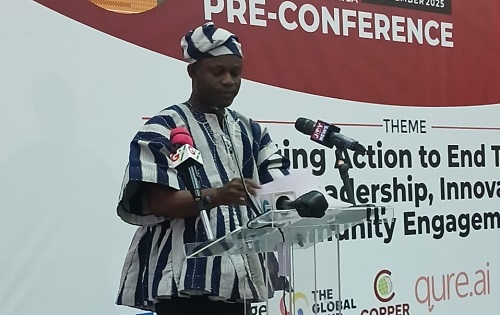
Health Minister urges Africa to pursue ‘health sovereignty’ at ICASA TB pre-conference
The Minister of Health, Kwabena Mintah Akandoh, has called on African countries to take charge of their future by pursuing what he described as health sovereignty. He stressed that the principle did not imply that the continent did not need external support, but rather that it required partnerships “that made sense” and did not come with restrictive conditions.
He urged African governments to invest resources where they were most needed, prioritise domestic resource mobilisation, and commit more funding to their health systems.
“It is an undeniable fact that the health of the people in every nation is a wealth of the nation. You cannot have a productive country or a prosperous country without a very strong health sector. We in Ghana see any expenditure in the health sector not as cost, but as investment,” he said.
Mr Akandoh was speaking at the 23rd International Conference on AIDS and STIs in Africa (ICASA 2025) End TB Pre-Conference, themed “Acceleration action to End TB through political leadership, innovation and community engagement.”
More than 3,000 delegates from 85 countries are attending Africa’s largest conference on AIDS and STIs, which Ghana is hosting for the first time. The main five-day event is on the theme “Africa in action: Catalysing integrated sustainable responses to end AIDS, TB and Malaria.”
The minister, who delivered the keynote address, said investments in the health sector could yield “overwhelming economic returns”. He urged African countries to view health not as a social service but as a productive economic sector.
He highlighted some of Ghana’s ongoing initiatives to strengthen its health system, including the National Health Insurance Scheme, the Ghana Medical Trust Fund to support non-communicable disease care, and the free primary healthcare programme expected to begin in 2026.
Mr Akandoh emphasised the importance of collaboration across the continent, noting that diseases had no borders. He stated that Africa would only become stronger if countries learned from one another and joined forces to confront shared health challenges.
Turning to the conference theme, he said the fight against tuberculosis required deliberate political action. “TB will end if political leaders deliberately choose to fund it, legislate for it and prioritise it,” he said. He added that TB had historically been underfunded relative to its burden, and urged African leaders to introduce specific TB budget lines, increase domestic financing annually and adopt innovation as national policy instead of limiting it to pilot projects.
The World Health Organisation Ghana Representative, Dr Fiona Braka, said Africa’s efforts to end AIDS by 2030 required strengthened health systems and integrated responses that put people at the centre of care. She explained that WHO continued to provide guidance on leveraging the strengths of the HIV response to support universal health coverage and build resilient systems.
She underscored the need to integrate HIV, TB, malaria and other essential services into primary healthcare delivery, supported by empowered community health workers. She also highlighted the importance of expanding access to new tools such as injectable pre-exposure prophylaxis for women and marginalised groups.
Dr Lucica Ditiu of the Stop TB Partnership in Geneva stressed that the primary concern must be ensuring that everyone, regardless of background, had access to the right diagnosis, quality treatment, reliable tests and the most up-to-date medicines without barriers.
