
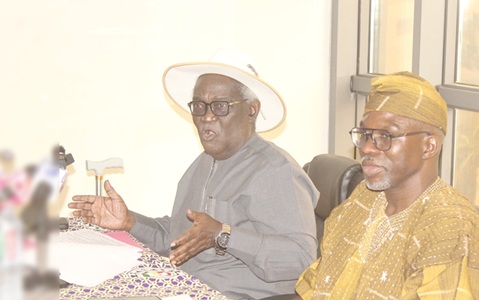
Decentralisation must not threaten national unity — Prof. Ahwoi
The longest-serving Minister of Local Government in the Fourth Republic, Prof. Kwamena Ahwoi, has cautioned that decentralisation, if not carefully managed, could fuel separatist tendencies and threaten national unity.
He said Ghana’s decentralisation system was deliberately designed with a weak regional structure to prevent secession and the eventual disintegration of the state.
“In decentralising, you must be aware that there are separatist tendencies. It is very easy to move from decentralisation to separation, to federalism, to balkanisation, to secession and to the breakdown of the country,” he stated.
He explained that Ghana, like many African countries, was an “artificial colonial construct” created through colonial rule and, therefore, required careful governance arrangements to maintain cohesion.
“Don’t ever think that Ghana can remain or will remain Ghana forever.
Ghana, like almost all African countries, with the exception of Ethiopia and Liberia, is an artificial colonial construct,” he said.
Prof. Ahwoi said this during a presentation on key principles and concepts in decentralisation and local governance at a sensitisation and policy orientation workshop for media practitioners on decentralisation and local governance in Accra last Tuesday.
It was organised by the Inter-Ministerial Coordinating Committee on Decentralisation (IMCCoD).
Historical examples
Prof. Ahwoi, who is also the Chairman of the Technical Committee, IMCC, cited the former Yugoslavia and the Union of Soviet Socialist Republics (USSR) as examples of states that eventually fragmented into several independent countries despite years of political union.
According to him, Yugoslavia, once a single country, later broke into multiple states, including Bosnia-Herzegovina, Kosovo and Serbia.
He also referenced the breakup of the USSR into about 15 countries, including Ukraine, which he described as the intellectual centre of the Soviet Union.
“It existed for over 70 years and then broke up, with each state going its different way,” he said.
Nigeria’s civil war
Prof. Ahwoi further referred to Nigeria’s civil war as another example of the dangers associated with strong regional structures and separatist ambitions.
He recounted how Nigeria initially operated with three powerful regions — the Northern, Eastern and Western regions — each possessing significant resources and population.
According to him, tensions escalated when Lieutenant Colonel Chukwuemeka Odumegwu Ojukwu declared the secession of Eastern Nigeria to form Biafra, leading to a three-year civil war.
“By the end of that war, one million people had died,” he said.
He stressed that the lesson from such experiences was that decentralisation, although beneficial, must not be allowed to undermine the unity of the state.
Ghana’s unity
Prof. Ahwoi noted that some traditional kingdoms in Ghana, including the Ashanti and Dagomba kingdoms, possessed characteristics that could potentially support statehood if governance systems were not carefully structured.
“Ashanti could easily be a country; Dagomba Kingdom could easily be a country. We do not want to fashion out a governance system that will give an excuse for Ghana to break up,” he cautioned.
He, however, commended past leaders and traditional authorities for helping to preserve national unity over the years.
Prof. Ahwoi reiterated the need for vigilance in implementing decentralisation policies to ensure they strengthen governance and development without endangering the country's cohesion.
