
Politics and the greening of Accra
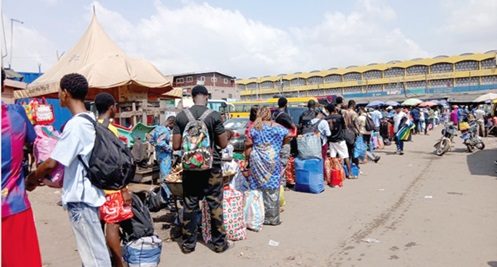
Social media are currently filled with tales of woe regarding Accra’s public transportation.
Horror stories abound of 20-kilometre journeys from Accra’s furthest reaches taking three hours each way, with some workers leaving home as early as 3am to get to work in the centre of town on time.
Accra’s roads, by and large designed and constructed before the current era, simply cannot cope with the volume of traffic.
What’s to be done? Some say that the government should provide new, faster, improved means of public transport.
Others suggest that car ownership should be greatly expanded so commuters don’t have to suffer the indignities and turmoil of Accra’s expensive and inadequate public transit system.
Accra’s public transportation crisis is but one aspect of a wider crisis of the environment in Ghana. A recent study by KNUST’s Dr Stephen Appiah Takyi and Prof. Owusu Amponsah evaluated economic viability, environmental resilience, and social development in Accra, Kumasi and Cape Coast.
Utilising a ‘Global Platform for Sustainable Cities’ framework, Dr Takyi and Prof. Amponsah discovered that Accra has lost more than 40 per cent of its green spaces in the last decade.
Green spaces
Why does it matter if Accra loses its green spaces? Accra’s metropolitan area, home to an estimated 5.6 million people, is experiencing a decline in environmental stability marked by the rapid loss of vegetation, raising concerns about long-term habitability and increased vulnerability to climate change.
Increasing environmental vulnerability is manifested in increasingly unbearable urban heat, greater flooding, and poorer air quality.
Add in the effects of three-hour commutes to get to work and what you have is an environmental crisis of potentially catastrophic proportions.
As the investigative journalist, Kent Mensah, recently noted in The Africa Report, ‘Accra’s vanishing green spaces are turning Ghana’s capital into a concrete jungle, fuelling floods, pollution and a quieter crisis of mental health’.
Accra is rapidly losing its green spaces due to intense urbanisation, a process which has changed the city from one of Africa’s greenest, replete with parks and tree-lined areas, into a ‘concrete jungle’ with increased heat, flooding, and pollution.
Efforts to address the crisis have been sporadic and, so far, ineffectual, with little apparent impact on restoration of vegetation and overall environmental quality.
Climate mitigation
What’s to be done? Over the last few years, successive governments have announced policies and projects to tackle Ghana’s environmental crises, including illegal mining (galamsey), deforestation, and pollution, via national action plans for climate mitigation.
The government has adopted laws, such as the 2025 Environmental Protection Act, invested in adaptation, including sea defences and waste management, and sought to promote renewable energy.
Despite such measures, serious challenges persist, whose solutions require more enforcement, funding, and meaningful policy implementation.
Politicians are keen to talk the talk of environmental sustainability but it is not apparent that they regard the issues as urgent: by and large, green issues remain marginal in plans to improve the quality of life.
How to make Ghana’s population centres, including Accra, greener? Improved policies are necessary in relation to waste management — including source separation and landfill gas capture — environmentally sustainable transport (such as, low-emission buses, shaded pavements and electric vehicle initiatives and incentives), sustained urban greening, renewable energy adoption (such as, net metering and solar) and, last but by no means least, stronger enforcement and robust legal frameworks for emissions and climate resilience.
In relation to the capital, such issues are covered in the Accra Climate Action Plan, 2020-2025 (https://policycommons.net/artifacts/3710891/accra-climate-action-plan/4516737/), focusing on waste optimisation, promoting green buildings, expanding public transport, and integrating climate action into spatial planning, supported by community engagement.
Politicians
None of these measures will have the desired impact without sustained support from those with power, chivvied by civil society.
Politicians talk the green talk, but don’t consistently walk the green walk.
Green issues are still often seen as a luxury, allegedly marginal to the concerns of the ‘ordinary’ man and woman.
It is time to stop talking about environmental sustainability: Accra and other population centres are at a critical juncture, struggling with rapid urbanisation that diminishes green spaces.
What is needed is much greater awareness and sustained efforts to implement smarter urban planning for a greener future.
The writer is Emeritus Professor of Politics, London Metropolitan University, UK
