
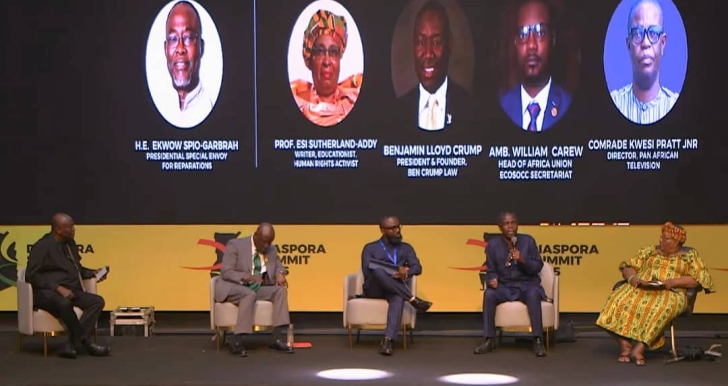
Pan-African Progressive Front anchors Reparatory Justice at Accra Diaspora Summit
The Accra Diaspora Summit, held at the Accra International Conference Center on 19–20 December, marked a historic convergence of African states, diasporic communities, and organised Pan-African political forces around the demand for reparatory justice.
At the centre of the summit were two foundational state interventions: one delivered by H.E. President John Dramani Mahama of Ghana, and the other by H.E. Faure Essozimna Gnassingbé, President of the Council of Ministers of the Republic of Togo. Together, these speeches framed reparations not as memory work alone, but as a political project concerned with truth, power, healing, and Africa’s place in the world.
Surrounding these state interventions, organised Pan-African movements, most notably the Pan-African Progressive Front, reinforced the urgency of moving from declaration to political action. Contributions from Senegal and CARICOM further demonstrated that reparations are increasingly being treated as a matter of continental and transnational governance rather than symbolic diplomacy.
President Mahama: History, Memory, and the Reclamation of the African Story
President John Dramani Mahama grounded his address in historical specificity and narrative reclamation. He began by insisting on the literal meaning of violence inflicted on African bodies, stating that enslaved Africans were “blood and bone that were forced onto ships and transported across the Atlantic.” He posed a central question that framed the moral urgency of the summit: “But why do these events that followed cease to be part of Ghana’s story also?”
Placing Ghana within the geography of the transatlantic slave trade, Mahama reminded the audience that “between the 16th and 19th centuries, nearly 13 million African men, women, and children were captured and transported on ships through the Middle Passage.”
He noted that “over two million of them died, some due to the harsh conditions and others due to disease,” while also acknowledging those “who chose to end it all” and those who perished when “ships sank in storms on the Atlantic.”
He described the Atlantic and the Gulf of Guinea as sites of mass death, stating that Africans were “shackled and chained limb to limb, turning the Gulf of Guinea and the waters of the Atlantic beyond it into a graveyard of our ancestors.”
He emphasized Ghana’s central role in this history, observing that “Ghana contains more slave forts and castles than any other nation on the African continent,” with many still intact and others lying in ruins.
For him, the suffering of those who were enslaved and those who remained on the continent cannot be separated. He declared that “what followed for each and every one of those individuals is as much a part of Ghana’s story as what followed for us who remained firmly rooted here on our soil but were subjugated and rendered second-class citizens nonetheless.”
He traced the origins of European extraction, noting that “the Portuguese were the first Europeans to land on our shores,” first extracting gold and commodities before “they moved on to the extraction of human beings.” He explained the cruel irony of the Volta River’s naming, stating that “‘Volta’ in Portuguese means ‘to return’,” and that even as Africans were forced through the Door of No Return, “their captors had already ensured their own safe return.”
Quoting Ghanaian-American author Yaa Gyasi, Mahama reminded the audience that “we believe the one who has power. They are the one who gets to write the story.” He urged listeners to interrogate history by asking, “Whose story am I missing? Whose voice was suppressed?” He argued that reclaiming these stories allows Africans and the diaspora “to write ourselves truthfully and respectfully into not only our future, but the future of all humanity.”
Mahama welcomed the diaspora explicitly, declaring, “This is your home.” He warned that division remains the central mechanism of domination. He rejected colonial borders, ethnic hierarchies, colorism, and systemic racial imagery that portray Africans as inferior. He stated plainly, “Colonization did not leave us unscathed.”
He highlighted cultural survivals across the diaspora, from language to food to folklore, arguing that Africa has remained present “well beyond food and music.” Drawing on Kwame Nkrumah, he recalled the statement, “I’m not African because I was born in Africa, but because Africa was born in me,” situating the diaspora’s centrality within Ghana’s foundational Pan-African vision.
Turning to reparations directly, Mahama declared, “We demand the acknowledgement of these crimes against humanity. We demand the establishment of legal, institutional, and international mechanisms to advance reparative justice.” He specified that reparations “must include tangible measures such as debt cancellation” and the transformation of the global economic system.
He closed with urgency and confidence, stating, “The future is African. We hold in our hands the power to change the circumstances of our past.” He called for unity, concluding that “with a united Africa and diaspora, there is nothing we cannot achieve.”
Reparations as reconstruction
President Faure Gnassingbé approached the question of reparations through a structured political framework. He opened by declaring, “The reparations movement is not a nostalgic provocation. It is a demand for justice, a condition for stability, and a lever of transformation for generations to come.” He rejected portrayals of Africa as dependent, stating, “Africa is not a wounded continent asking for assistance. Africa is a collective force demanding equity, recognition, and truth.”
Gnassingbé argued that reparations are future-oriented, explaining that slavery and colonization “configured the global economy” and produced “productivity inequalities, trade asymmetries, technological gaps, and institutional fragilities.” He stressed that these mechanisms “are not behind us.”
He insisted that truth is the first step, stating that “the world must formally recognize that the transatlantic slave trade was a crime against humanity.” He praised Ghana’s initiative, describing it as “a foundational act” that allows the world “to heal wounds and rebuild the future on solid foundations.”
Gnassingbé emphasized that “truth alone is not enough,” asserting that “reparations require instruments,” including debt restructuring, multilateral funds, and United Nations commitments. He described reparations as “an act of global reconstruction” that contributes to world stability.
On the diaspora, he stated unequivocally, “Our diaspora is not a memory or a relic of history. It is a true political, economic, and intellectual extension of Africa.” He warned that “no strategy of sovereignty can succeed without the mobilization of the diaspora.”
He described healing as a political imperative, stating, “This work of healing is not a moral add-on; it is a strategy of power.” He called for Africa, ECOWAS, CARICOM, and the African Union to speak “with one voice.”
Gnassingbé concluded by rejecting charity narratives, stating, “In demanding reparations, Africa is asking neither for charity nor compassion. It is asking for equity, recognition, and justice.” He described the summit as “a rare moment” to build a lasting Africa-diaspora alliance and declared that Africa is “finally taking its future back into its own hands.”
The Role of PPF and Organised Pan-Africanism
Within this state-led momentum, the Pan-African Progressive Front intervened as an organised political force committed to advancing reparations beyond diplomacy. PPF coordinating member Kwesi Pratt Jnr. situated reparations within the realms of political economy and mass organisation rather than elite negotiation.
PPF reaffirmed its commitment to the Special Accra Declaration on Reparatory Justice, adopted earlier in November this year, which calls for a reparations fund, cancellation of illegitimate debts, the return of stolen resources, and binding enforcement mechanisms.
Caribbean alignment was reinforced through the intervention of Arley Nichau Salimbene Gill of the Grenada National Reparations Committee, speaking on behalf of CARICOM. Gill affirmed that slavery was a crime against humanity and emphasized that “the cost of this repair must be borne by those who did it.” His articulation closely mirrored PPF’s position that dignity and self-determination do not negate historical obligation.
PPF also advanced transnational solidarity by presenting a copy of Mr. Pratt’s book on reparations to Fred Hampton Jr. and Benjamin Crump, symbolically linking African reparations struggles with Black radical and legal traditions in the Americas.
Toward a New Pan-African Cycle
The Accra Diaspora Summit demonstrated a shift in Pan-African politics. Reparations were no longer framed as an appeal, symbolism, or commemoration alone. Through the combined weight of Ghana, Togo, Senegal, CARICOM, and organised Pan-African movements such as PPF, reparations emerged as a structured political project grounded in politics, law, history, and collective power.
As President Mahama declared, “This is precisely the time when we must advance and begin the process of reclamation.” The summit marked not an ending, but the opening of a new Pan-African cycle rooted in unity, justice, and the deliberate reconstruction of African destiny.
