
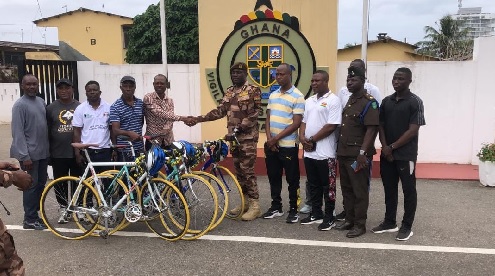
The Ghana Cycling Federation (GCF), in partnership with the African Cycling Network Satellite, has presented four Sports Racing Bicycles to the Ghana Prisons Service, signalling the start of a concerted effort to establish competitive cycling teams within the country’s security agencies.
The donation, which took place at the Prisons Service headquarters in Accra, is the first step in a broader campaign to build cycling structures for the Ghana Prisons Service, Ghana Police Service and Ghana Armed Forces, with an eye on continental and global competitions.
Speaking at the handover ceremony, GCF Secretary General Shaaban Mohammed observed that Ghana currently has no dedicated security services cycling team, despite such squads being a regular feature at security games across Africa and beyond.
“Security services games are organised annually on the continent, but Ghana has so far only sent officials as observers,” he said. “Ghana cares and is involved in all aspects of sports, and cycling should not be left out.”
Mr Mohammed explained that the federation identified potential talent within the Prisons Service after officers were spotted cycling alongside professional riders during a Parkinson’s disease awareness event in Legon. He noted that several of those officers already cover distances of 40 to 50 miles on their own, which convinced the federation that a talent base worth developing exists.
He further stressed that establishing a structured cycling pathway within the security services could serve as a recruitment incentive, encouraging young people who take up serious training to consider careers in the services.
“If the youth are not being taken care of, we do not have a future country,” he said.
Receiving the bicycles, Deputy Director of Prisons Fiifi Dontoh, who oversees procurement, expressed appreciation for the gesture and noted that while the service is active in football, boxing and athletics, cycling has remained an informal activity among interested officers.
He said the donation would now allow the service to formalise training and build a team capable of competing internally and, eventually, in national colours.
Mr Mohammed added that the Ghana Police Service and Ghana Armed Forces are also in the process of forming cycling teams, but the Prisons Service is the first to receive a bicycle donation from the federation.
He expressed hope that the initiative would also encourage the Ghana Immigration Service, Ghana National Fire Service and other security agencies to establish their own cycling programmes, thereby raising the overall profile of the sport.
On behalf of the Prisons Service, Mr Dontoh thanked the federation and the African Cycling Network Satellite for the donation, describing it as an invitation into the cycling fraternity that the service intended to honour by developing genuine competitive talent among its officers.
