


CIPA Holdings Group is positioning Ghana as an emerging destination for global climate and renewable energy investment through innovative financing frameworks designed to attract long-term international capital.
The company stressed that growing interest from investors, particularly from the Gulf region, reflected increasing confidence in Ghana’s renewable energy and climate-resilient infrastructure potential.
It explained that its integrated financing model was helping to bridge global capital with bankable local infrastructure projects, while creating commercially viable investment opportunities in the clean energy sector.
According to the company, strengthening institutional trust, improving project structuring and deepening partnerships with financial institutions would be critical to accelerating Ghana’s low-carbon economic transformation.
“At the heart of the energy transition is capital, but more importantly, trust. Our focus has been on building platforms that investors can rely on to deploy capital into infrastructure that is both bankable and impactful,” the Founder and Chief Executive Officer (CEO) of CIPA Holdings Group, Kwaku Osei-Sarpong, said in an interview.
Credible partner
Following its recent feature in the Gulf News UAE Global FDI Report (Focus on Ghana) - a flagship international platform connecting global investors, sovereign wealth funds and development finance institutions to high-growth markets, the CEO stated that reinforcing its position was a credible partner in mobilising and deploying capital into Ghana’s renewable energy and climate-resilient infrastructure sector.
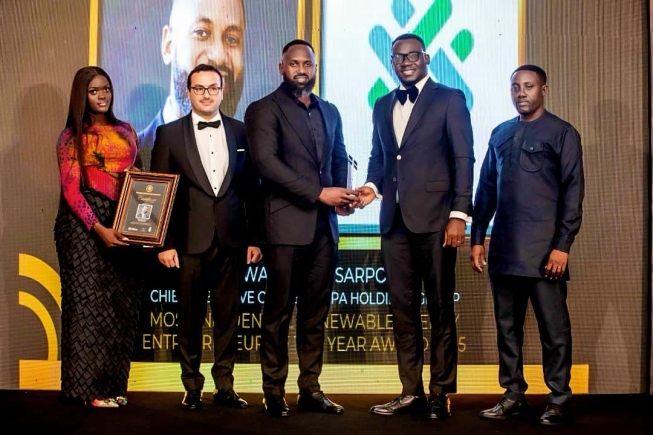
The company’s growing recognition was further underscored by its Founder’s recent honour at the Ghana Entrepreneurs & Corporate Executives Awards 2026 ceremony held in Accra, reflecting increasing confidence in its leadership within the renewable energy sector.
“As Ghana accelerates its transition toward a low-carbon and climate-resilient energy system, the scale of investment required continues to grow.
Increasingly, the challenge is not the availability of capital, but the ability to structure and deploy that capital into bankable, scalable projects.
“CIPA Holdings Group is positioning itself at the centre of this shift by developing financing frameworks that bridge global capital with local infrastructure opportunities.
Through its integrated model, the company is enabling both domestic and international investors to participate in Ghana’s renewable energy transition in a structured and commercially viable manner,” he said.
He said this approach comes at a time when global capital, particularly from the Gulf region, was actively being redirected toward renewable energy, climate-aligned infrastructure and low-carbon technologies.
Deep investments
As economies such as the United Arab Emirates expand their focus beyond hydrocarbons and deepen investments in the global energy transition, markets like Ghana are increasingly attracting attention as viable destinations for long-term capital deployment.
For CIPA, the opportunity lies in providing the institutional framework through which that capital can be deployed with confidence.
A core element of this strategy is the aggregation and structuring of renewable energy assets into scalable investment platforms.
By moving beyond single-project development and creating portfolio-based approaches, CIPA is addressing one of the key constraints in infrastructure investment across emerging markets - fragmentation.
This approach enhances visibility for investors, improves risk allocation and enables capital to be deployed more efficiently across multiple projects.
It also aligns closely with the requirements of institutional investors such as pension funds, sovereign wealth funds and development finance institutions, which typically seek scale, predictability and governance.
In parallel, the company is actively deepening collaboration with local financial institutions to strengthen domestic capital participation in the energy transition.
This includes working with local fund managers to mobilise local currency financing for climate-aligned infrastructure, helping to reduce foreign exchange risk for off-takers while unlocking long-term capital from pension funds and asset managers within Ghana.
Sustainable financing strategies
CIPA is also supporting banks in the design and implementation of their sustainable financing strategies, helping to originate and structure pipelines of renewable energy and climate-resilient infrastructure projects that meet both regulatory expectations and commercial investment criteria.
By aligning project development with the evolving sustainability frameworks of financial institutions, the company is contributing to the development of a more mature and responsive green finance ecosystem in Ghana.
In parallel, the company continues to innovate in financing structures, integrating models such as energy-as-a-service and blended finance and project-level SPVs.
These frameworks allow industries, commercial entities and public institutions to transition to clean energy without upfront capital expenditure, while providing investors with stable, long-term revenue streams.
“Investors are looking for opportunities that offer both impact and financial discipline.
“Our role is to structure investments in a way that aligns these objectives, ensuring transparency, risk management and long-term value creation,” the Chief Financial Officer of CIPA Holdings, Bright Yamoah.