

Across Ghana, the scars of illegal mining, commonly known as “galamsey”, are written on poisoned rivers, abandoned pits and fractured communities.
For decades, successive governments have promised to fight the menace.
Task forces and campaigns such as Operation Vanguard and #StopGalamseyNow have captured headlines.
Yet, beneath the surface, the problem persists, gnawing away at the environment and the very fabric of society.
At Ayanfuri, a town in the Upper Denkyira West Municipal in the Central Region of Ghana, the tales of galamsey aren’t any different.
Ayanfuri is both blessed and cursed. It hosts Perseus Mining Ghana Ltd, a large-scale mining company with legal concessions.
Yet, surrounding its operations are hundreds of unregulated miners digging with shovels, metal detectors and mercury.
The result is visible: deforested hills, polluted streams and dangerous pits.
The Offin River, once a reliable water source, now runs muddy, carrying traces of mercury and cyanide.
However, for many residents, galamsey is not just about environmental destruction; it is about survival - making a living in a world of limited economic opportunities.
‘Galamsey is dire, but I can’t sit home’
A 38-year-old man, a resident of the community and an active participant in galamsey, admitted that although he was aware of its harmful effects, he continued engaging in it due to prevailing circumstances: “I know mining destroys the land, but I cannot sit at home with no work while my children are hungry.
Galamsey is what puts food on the table.”
Galamsey is more than an environmental crime. It is a struggle for survival, shaped by poverty, unemployment, and the lure of gold.
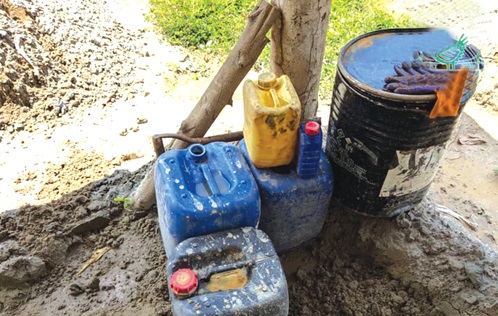
Acid and cyanide containers
It is also a story of conflicting interests between the government, mining companies, traditional leaders, and ordinary citizens.
Few places embody this tension better than Ayanfuri.
With few jobs available, galamsey becomes the most immediate means of survival.
For many young men, especially students, the quest to make what they consider to be ‘quick money’ to buy motorbikes, smartphones, and status symbols is alluring.
Workers with low incomes are often driven to engage in galamsey because they see it as a quick path to wealth.
Confessions, radio presenter
A 38-year-old former radio presenter in Kumasi confessed that he abandoned his broadcasting career to venture into illegal mining, as it provides him with far more income than his previous job.
“I worked at a radio station in Kumasi,” Ponsy (not original name) confessed.
Ponsy explained why he left the radio mic for the gold mine: “The pay was too small. Here, I earn more, although I know it is a risky job.
Yet, at least I can feed my family”.
Some students of Ayamfuri Senior High School explained why they are motivated to skip classes and other academic activities to engage in galamsey.
"I engage in illegal mining to buy myself things such as new mobile phones, motor bikes and other stuff I know my parents cannot afford for me."
Peer pressure, weak enforcement
Others also join because of peer pressure; “I see my friends who are engaged in illegal mining making more money, and I also want to make some.
That is why I sometimes leave school and go to the site.”
Another major motivation is weak enforcement of laws by authorities: Some miners confessed that even when laws exist, enforcement is inconsistent, leaving them free to operate.
In dealing with the police, illegal miners in the town are not afraid, as they claim officers often take money from them whenever they are spotted transporting equipment in their tricycles, popularly referred to as "aboboyaa" to mining sites.
As a result, they pay little attention to police presence.
However, when military personnel raid their sites, they are forced to flee, since the soldiers are far less lenient than the police.
‘We are all chasing gold’
Many illegal miners at Ayanfuri cite political interference as also a motivation.
In election seasons, local leaders are reluctant to crack down on miners for fear of losing votes.
One miner put it bluntly, “We see the big men driving cars bought with money from gold.
Why should we suffer when the land is in front of us?
Whether legal or illegal, everyone is chasing gold.”
Perhaps the most difficult challenge is that illegal mining feeds on desperation.
For many, the immediate need to survive outweighs the long-term dangers.
As one health worker in Ayanfuri observed: “People know the risks, but they cannot stop because they have no other way to live.”
This makes galamsey not just an environmental crime, but a deeply human problem tied to poverty, inequality and broken trust.
Legal vs illegal mining
Residents accuse Perseus Mining of reaping profits while they remain poor.
The company, in turn, blames illegal miners for trespassing and endangering operations.
Similarly, while chiefs often condemn galamsey, some youth suspect that leaders secretly benefit through concessions or bribes.
Government bans on small-scale mining without providing alternatives are considered heavy-handed by miners who depend on galamsey for their livelihoods.
While parents worry about their children abandoning school to mine, many remain silent because the income pays household bills.
These fractured relationships create mistrust and complicate collective action against galamsey.
Because galamsey is both a livelihood and a highly sensitive issue, many community members are reluctant to speak openly about it.
Conversations are often guarded, with miners fearing exposure or possible reprisals.
Accessing galamsey sites is a real challenge.
These areas are usually remote, dangerous, and tightly controlled by those who profit from the activity.
More than battle over land, water
The fight against galamsey is more than a battle over land and water; it is a struggle that cuts across livelihoods, politics, and the survival instincts of entire communities.
Our investigations in Ayanfuri revealed both the national complexities and the on-the-ground realities that make tackling illegal mining so daunting.
Yet, these challenges also present an opportunity, a call for renewed commitment, collaboration, and creativity in the search for solutions.
The persistence of galamsey shows that enforcement alone cannot address the crisis.
Ayanfuri's story is Ghana's story.
It is the story of a people caught between survival and sustainability, of strained relationships and unrelenting needs.
But it is also a story of resilience, of communities willing to listen and the power of dialogue.
