

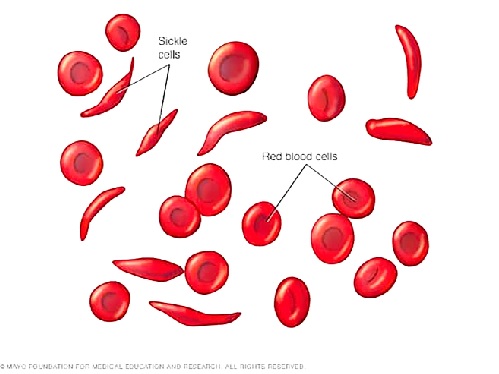
Is it possible to have a child with sickle cell?
Dear Doctor, I am negative, and she is positive, so I had another test, which proved that she did not have sickle cell disease, and so we went ahead and got married.
Can you please explain to me if it is possible to have a child with sickle cell disease?
I read your response last week, but I need to be clear about my situation. I am seriously considering a DNA test. Patiently awaiting your response.
Papa, Accra.
Dear Papa, Sickle Cell Disease is an inherited disorder in which one has inherited two abnormal haemoglobins from both parents, one of which must be the Haemoglobin S.
Sickle Cell Anaemia (SCA) results when both abnormal haemoglobin chains are of the S type.
Looking at your request, you can have a child with sickle cell disease. What you cannot have is biological children with Hb SS (SCA) so long as the test results of the two of you remain authentic.
What I see happening here is that you stopped at the sickling test because your result was negative.
A negative sickling test does not automatically translate into normal haemoglobin results, and that is what I see happening here.
The sickling test will be positive only if the person has an abnormal haemoglobin of the S type.
Whether you have only one haemoglobin being S or both being S, the sickling test will be positive. The other abnormal haemoglobin of C Bthal and others will not come up as positive.
Even though you were silent on the exact type of sickle cell disease your child has, it is more likely to be SC or SBThal genotype.
In that case, your wife testing positive for the sickling test means she is AS. Your test result coming out as negative means you are either AC or ABthal genotype.
This might have convinced you that you are AA, but in reality, you may not be (I say may not be upon the assumption that you are the biological father). This is the reason why it is never conclusive to end at the sickling test.
The haemoglobin electrophoresis MUST always be done even if the sickling is negative because of the reasons adduced above. Assuming that you have normal haemoglobin when sickling is negative has resulted in a lot of needless paternity disputes.
So, for your child to have sickle cell disease implies that he/she has inherited a sickle cell gene from each of you. Definitely S from mum and possible C or Bthal from you.
An electrophoresis of your haemoglobin will tell exactly what you have.
Someone who inherits only one sickle cell gene and a normal gene from the other parent will have the sickle cell trait, but not the disease, and that is probably what both of you have.
People who carry the trait don't have sickle cell disease or exhibit any signs of the disorder, but they can still pass the disease on to their children.
A more urgent discussion to have is the chance of your next child, if you so desire to have more. With the most probable carriers in your case, there is a 25 per cent chance that your next child will have the sickle cell disease.
Please note that when we say that there is a one in four (25 per cent) chance of having a child with the disease, what it means is that with each pregnancy, there is a 25 per cent chance of having a child with sickle cell disease.
Please note that it is not the case that when you have four children, one of them will have the disease. In fact, it could be that if you two decide to have three children, all three could have the disease, escape the disease or have different combinations.
This notwithstanding, there are other couples with the trait that have decided not to have children and have enjoyed their marriage. Also, certain couples with the trait have had children who are all either free of the disease or are at worst carriers.
The choice for more children will solely be a decision of the family. As for the paternity test, it still remains your prerogative, since I have made a lot of assumptions in response to your question.
The question as to whether you can father a child with sickle cell disease, based on your question, is a big YES, based on the assumption that you are a carrier with a non-sickling abnormal haemoglobin.
The writer is a member of the Paediatric Society of Ghana and the Director of Medical Affairs, Korle Bu Teaching Hospital.
