
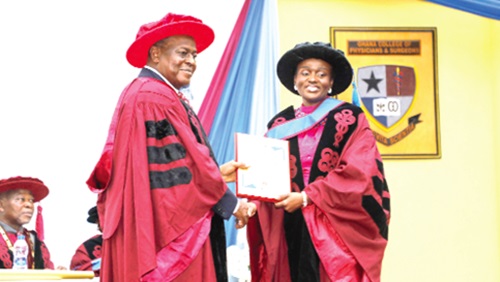
350 Physicians, surgeons inducted into Ghana College
The Ghana College of Physicians and Surgeons (GCPS) has inducted 350 members and fellows into the college.
They are made up of 299 members, 14 fellows by election and 37 fellows by examination.
They were from various fields of medical speciality, including internal medicine; paediatric and child health; obstetrics and gynaecology; orthopaedic and tremor surgery and public health.
In addition, there were three diplomats from the Faculty of Anesthesia, and two fellows who received a post-fellowship diploma in the Faculty of Surgery and Subspecialties.
The examinations were held in March and September.
There were also graduating members from the Faculties of Family Medicine and Obstetrics and Gynaecology.
The induction came off at the 22nd Annual General and Scientific Meeting Fellowship of the college, and was on the theme: “Transforming Medical Training in Ghana: Leveraging AI & Tackling Economic Realities ".
Some residents and senior residents were honoured with awards
Specialist
The Rector of the GCPS, Professor Richard Adanu, said the country needed at least 6,200 additional specialists by 2030 to meet its national healthcare needs.
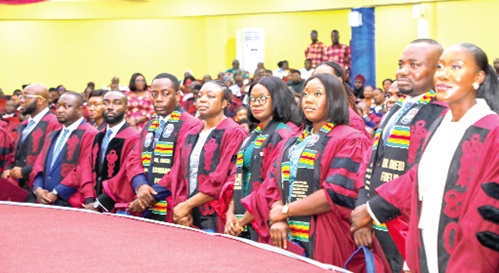
He expressed the hope that all graduating Fellows would actively be involved in training and contributing significantly to increasing the specialist workforce in Ghana.
He said the number of doctors enrolling in the training programmes had increased over the years, leading to a corresponding rise in the number of graduates.
“We must ensure that our hospitals are well equipped and guided by the right policies to demonstrate our commitment to the highest standards of medical practice. Graduating as Fellows of this College should not be seen merely as a personal badge of honour.
“It comes with the responsibility to deliver services of high ethical and professional standards, and to train all categories of doctors, thereby contributing to the production of more specialists for the country,” he added.
Commitment
Prof. Adanu reaffirmed the College’s vision of establishing training programmes in all regional and teaching hospitals, beginning with seven core fields: Anesthesia, Emergency Medicine, Family Medicine, General Surgery, Internal Medicine, Obstetrics and Gynaecology, and Paediatrics and Child Health.
He said in line with the vision, new programmes had started in the Eastern, Western and Bono East regions, with plans to roll out training in three additional regions by the end of next year.
The Rector, however, acknowledged challenges, including the limited number of fellows available to serve as trainers and inadequate specialised equipment in some hospitals.
To address gaps in training, he said the college had introduced a “Level B Accreditation” system that deployed. Fellows from other institutions to facilities lacking trainers.
The Rector expressed gratitude to the Ghana Physicians and Surgeons Foundation of North America and its leadership, support, donation of defibrillators, mannequins and other essential training equipment worth about US$25,000.
He said, this year, the Minister of Health and the Parliamentary Select Committee on Health had assured the college of improved funding and full support for its activities.
The President of the College, Professor Samuel Debrah, stressed the need for Africa to embrace innovation and cooperation in order to keep pace with the rapidly evolving global healthcare landscape.
He explained that health care was becoming increasingly expensive, particularly with modern diabetes treatments, AI-driven diagnostics, and other technological breakthroughs.
Prof. Debrah stressed that governments alone could not bear the cost.
“African governments committed in Abuja to allocate 15 per cent of national budgets to health.
Twenty-two years later, not a single country has achieved it,” he said.
Prof. Debrah called on the graduates to help reshape that culture by embracing innovation, working collaboratively and committing to lifelong learning.
