
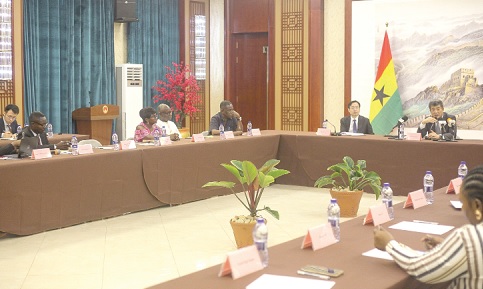
China-Ghana bilateral trade hits $14 billion
Bilateral trade between China and Ghana reached a record $14.1 billion last year, reflecting a 19.3 per cent year-on-year growth, the Chinese Ambassador to Ghana, Cong Song, has said.
He said China’s investments in mining companies, power plants, oil refineries, airlines, steel companies, ceramic companies and cement factories were deeply rooted in Ghana, creating hundreds of jobs and contributing to the economy.
“China is willing to work with Ghana to implement the outcomes of the meeting between President Xi Jinping and President John Dramani Mahama, and help Ghana transform its resource advantages into development momentum and achieve effective synergy between resource development and environmental protection.” Mr Cong was addressing the press in Accra on Monday.
24-Hour economy
The ambassador said China was willing to actively participate in the government’s 24-Hour Economy and Reset Ghana agenda by assisting to build the Volta Economic Corridor, bring in more capital, technology and processing of agricultural products to stimulate Ghana’s indigenous development momentum.
Mr Cong further spoke on five thematic areas - the Taiwan question, zero tariff treatment, China-Ghana economic and trade cooperation, China-Africa Year of People-to-People exchanges and China-Ghana mining cooperation.
On China’s zero-tariff agreement with 53 African countries that came into effect at the beginning of this month, Mr Song said that would undoubtedly bring unprecedented new opportunities to African countries, including Ghana, by injecting strong momentum into China-Africa trade and investment cooperation and the modernisation of the African economy.
“For example, Ghanaian cocoa previously had a tariff of 8 to 22 per cent, but after the zero-tariff treatment took effect on May 1,2026, cocoa and other products would enjoy zero tariffs on exports to China,” he said.
Trade cooperation
The ambassador also said that 2026 marked the beginning of China’s 15th five-year plan, during which it would focus on high-quality development, accelerate self-reliance in high-level science and technology, actively develop new productive forces, and build a modern industrial system.
He commended the government and said: “Ghana’s Gross Domestic Product grew by 6.0 per cent in 2025, with the inflation rate falling to 3.4 per cent by April 2026, demonstrating strong economic development momentum.”
On China-Africa Year of People-to-People exchanges, Mr Song said the two countries had deepened their friendship through people-to-people exchanges, fostering mutual understanding and affinity, adding that more than 10,000 Ghanaian students were learning about China and also connecting with the world through learning Chinese.
The ambassador further said that the Chinese government had always requested Chinese citizens overseas to abide by the laws and regulations of host nations, and therefore, frowned on Chinese citizens who engaged in any illegal activities.
Best practices
The General-Secretary of the Socialist Movement Ghana, Kwesi Pratt Jnr, said African countries should take examples from around the world and shape their own destiny since China would not determine policies they should adopt.
An executive member of the Ghana-China Friendship Association, Michael Kalley, said Ghana valued its relationship with China.
He said there was the need for African countries to strengthen their manufacturing capacity in order to industrialise.
