
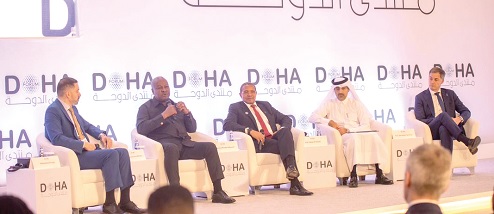
Doha Forum: Africa must adopt new practices to address challenges in agric sector — President
Africa must accept the reality of climate change and adopt new practices to address challenges in the agricultural sector, President John Dramani Mahama has said.
He said the over reliance on rains as a form of irrigation could no longer be the case, underscoring the need for more land to be placed under irrigation for all-year round and sustainable farming.
“We need to adopt agricultural practices to the new reality; and that means that we must put more land under irrigation.
“Poor farmers are not going to be able to afford the kind of cost it takes to put land under irrigation. So, that is where government comes in,” the President added.
President Mahama was addressing a forum in Doha, Qatar, last Sunday, on the topic: “Economic empowerment in Africa: Pathways to inclusive prosperity.”
The President, who described himself as a farmer, empathised with African farmers who were struggling with the impact of climate change.
He cited his experience on his 400-hectare farm, where crops wilted due to a 10-week drought, underscoring the need for investment in irrigation.
President Mahama added that the continent must move away from relying on smallholder, peasant agriculture and focus on medium to large-scale agriculture practices.
Event
The two-day Doha Forum 2025, that was on the theme: “Diplomacy, dialogue, diversity,” was a global platform where leaders in policy discussed critical challenges facing the world.
It was also aimed at promoting the interchange of ideas and discourse towards policy making and action-oriented recommendations.
Ghana’s delegation which was led by President Mahama, included the Minister of Foreign Affairs, Samuel Okudzeto Ablakwa; the Secretary to the President, Dr Callistus Mahama; the Deputy Chief of Staff in Charge of Administration, Stan Xoese Dogbe, and the Special Aide to the President, Joyce Bawa-Mogtari.
Blueprint
President Mahama, therefore, called on governments to invest in irrigation systems, particularly solar-powered water pumps to support farmers.
He also emphasised the importance of developing the agribusiness sector to provide ready markets for farmers' produce.
The President further said that his government had implemented initiatives to support farmers, and mentioned fertiliser subsidy, provision of improved seeds, and the introduction of a minimum guarantee price for maize to protect farmers from price fluctuations.
“For instance, in Ghana, we subsidise the cost of fertilisers in order to increase output. We subsidise the cost of improved seeds in order that farmers can have access to good seeds.
“The government has also embarked on a very ambitious programme of introducing irrigation that is appropriate and affordable to the farmer.
If you go and put some huge pumps connected to the national electricity grid, farmers cannot pay the tariffs for pumping that water.
“So, we are putting in more solar water pumps, improved seeds, good extension advice, including developing the agribusiness sector to establish an off-take for farmers produce,” he said.
President Mahama said while it was unfortunate that Africa missed the Green Revolution Africa, a technology transfer initiative which resulted in a significant increase in crop yields, it still had some of the most extensive arable lands yet to be put to productive use.
