
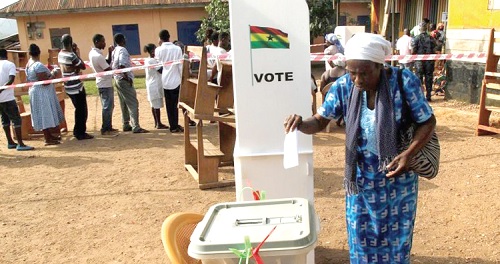
This past Sunday was December 7, exactly a year ago when Ghanaians went to the polls to decide whether to allow the New Patriotic Party (NPP) to “Break the 8” by handing them another term in office or to vote the main opposition party, the National Democratic Congress (NDC), back into office.
Today, we all know how the story of that election turned out. In retrospect, the result of that election offers us some very important food for thought.
Lessons from the 2024 election
First, is the Ghanaian voter’s use of the ballot box as a key accountability tool.
The civic engagement habits of the ordinary Ghanaian, as captured by the Afrobarometer, leave much to be desired except when it comes to voting.
This was clearly demonstrated in the mandate handed to the NDC both in terms of the vote margins in the presidential race and the number of seats in Parliament. In between elections, public officers may be able to escape the accountability efforts of citizens, but ultimately the ballot box becomes their undoing.
We say this in 2016 and again, and to an even greater degree in 2024.
Second, economic conditions matter and former President Kufuor and the NPP framed it best in the 2000 election when they forcefully argued that Ghanaians must examine their living conditions and then let that inform how they vote.
The same was true in 2024. There is no denying that Ghanaians faced some major economic pinch points, which were attributed to the NPP’s management of the economy.
In response, the message of change and the promise of better management of the economy resonated well with enough voters for the NPP to be voted out of power.
Third, perceptions of corruption cannot be overlooked.Between Afrobarometer Round 8 (2019) and Round 10 (2024), the percentage of Ghanaians saying corruption had increased a lot jumped from 38 per cent to 63 per cent.
Over the same period, the percentage of Ghanaians rating the government’s fight against corruption as “fairly well/very well” dropped from an already low of 39 per cent to 15 per cent.
In my opinion, the rigid position of approaching the fight against corruption as a matter of “due process alone”, hurt the President and his party as it created the impression that it was not interested in dealing with corruption.
Fourth, how a party governs has consequences.
In 2016, I recall my mother saying to me that voting for the NDC, given everything Ghanaians has experienced especially with the economy and “dumsor” it will send a wrong signal that governing has no consequences.
Her point was simply – poor governance outcomes must not be rewarded with electoral victory.
And in 2024, a dispassionate view of conditions in the country was enough to apply my mother’s standard to what needed to happen in that election.
Fifth, chairs of Electoral Commissions (ECs) do not guarantee electoral victory. In the lead-up to the 2016 election, the NPP did not hide its suspicion of the EC chair.
The same was true in the 2024 election, looking back at the many issues the NDC raised about the EC chair.
In both elections, neither of these returning officers had power over what Ghanaian voters were determined to do.
Sure, the parties will argue that their “protect the ballot” strategies ensured there was no electoral manipulation.
While their vigilance is helpful, the point remains that the Ghanaian voter is more powerful than any EC Chair.
Sixth, policies alone cannot save a government that Ghanaians are dissatisfied with.
It is instructive to note that, despite all the poor ratings in Afrobarometer Round 10 (2024) on matters such as trust, perceptions of corruption, central governance performance, etc, there was strong support for key policies of the NPP government – Free SHS (86 per cent); One district One Factory (76 per cent); Planting for Food and Jobs (81 per cent); and One Village One Dam (63 per cent).
The lesson here is that rolling out good policies is necessary.
However, the results of such good policies, the state of the economy, and other matters of good governance are helpful to improve the electoral prospects of an incumbent party.
Lessons for all incumbent parties
What should incumbent political parties take away from the 2024 election?
Ghanaian voters may have settled into an eight-year cycle for its two main political parties.
But the 2016 and 2024 elections illustrate an important point - Ghanaians will not shy away from showing an incumbent party the door if dissatisfied with conditions in the country.
Yes, an incumbent under favourable country conditions lost the 2008 election.
But the closeness of that election should tell you what kind of fate awaits an incumbent when conditions in the country are extremely unfavourable.
That is the biggest lesson I hope incumbent political parties will learn from what happened to the NPP in the 2024 election.
The writer is Project Director, Democracy Project.
