
ICASA 2025: Scale up integration of traditional medicine into primary healthcare system — WHO
The World Health Organisation (WHO) Ghana Office has urged African countries to scale up the integration of traditional medicine into their primary healthcare system and also invest in capacity-building.
It said that for Africa to attain universal health coverage, which a lot of them had signed on to, they must be serious about integrating traditional medicine into primary healthcare systems.
It has further encouraged countries on the continent to consider expanding herbal medicine units, including traditional medicine products and their health insurances, and continue to promote the collaboration between traditional medicine practitioners and the biomedical or allopathic practitioners.
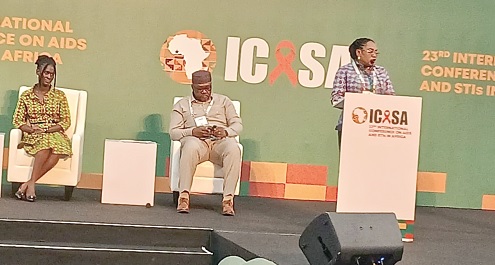
The Technical Officer, Quality and Safety of the WHO Ghana Office, Dr Angela Ackon, said this at the high-level meeting of the 2025 International Conference on AIDS and STIs in Africa (ICASA), which is ongoing in Ghana.
Over 3,000 delegates from 85 countries are attending the conference, which is organised by the Society for AIDS in Africa (SAA). Alongside the conference, which is the 23rd edition, is the celebration of the 35th anniversary of SAA.
Together with the Head of Department of Clinical Research at the Centre for Plant Medicine Research, Mampong Akuapem in the Eastern Region, Dr Mavis Boakye-Yiadom, they spoke on the topic, "Strengthening the role of traditional medicine in primary healthcare in West Africa".
Overview
Both experts stated that globally, 80 per cent of populations used traditional medicine for various conditions and in Africa, studies had shown that about 80 per cent of the population also relied on traditional medicine for their health needs and which they pointed out, indicated acceptance of traditional medicines globally and continentally.
Traditional medicine products registered on the continent in 2000 were 20, and as of 2023, they had increased to 100. Allocation of funds for research in traditional medicines has also doubled, and this, they said, was an indication that the continent had progressed on all indicators related to traditional medicine.
Dr Ackon said Ghana, in 2012, had 19 facilities that had integrated traditional medicine into their healthcare system and that increased to 55 in 2023, which was the same as Tanzania, which offered both traditional medicine and biomedical treatment for patients.
Advantages
On the advantages of the integration, Dr Ackon, whose presentation was titled “Global perspectives on integrating traditional medicine into primary healthcare,” said lessons from countries such as China, Vietnam, Japan and Korea, that had fully integrated traditional medicine into their primary healthcare systems were an indication that there were advantages to advancing the discussion on the integration of traditional medicine into primary healthcare systems.
She mentioned the advantages to include enhanced access and health equity, where there was a wider reach to the public, especially those who were in underserved areas and the provision of a holistic approach to the promotion of health, where the care provided was patient-centred, with better management of conditions as well as reduced side effects.
On the economic benefits of such integration, she said there was optimisation of resources used towards the advancement of science and innovation.
She called on stakeholders to support policies, encourage innovation, as well as the engagement with the community, if they were to keep the products safe and effective, and keep the practice relevant within their healthcare systems.
Dr Ackon's presentation also touched on various strategies and plans of action the WHO had developed in relation to traditional medicine practice.
NHIS
Dr Boakye-Yiadom said that although 55 facilities in Ghana had done the integration, the National Health Insurance Scheme (NHIS) did not cover herbal medications prescribed, adding that there was a need to push for traditional medicines to be recognised.
She mentioned the social challenges with traditional medicines to include difficulty in assessing safety and efficacy standards, adding that there was a need to ensure that traditional medicines were of the same standard.
“The most important thing is that we are using plants, but then we are not growing these plants.
We are not putting them back as we are supposed to do.
“So with time, these plants might go extinct, and this is something that we need to work at.
We need to put up more of our plant medicine farms so that in the end, we don’t get locked up,” she added.
