
Ghana has successfully ended the financial bailout programme with the International Monetary Fund (IMF).
It has subsequently transitioned to a non-financing technical assistance of the fund to protect the gains and unlock other benefits.
Known as the Policy Coordination Instrument (PCI), it is a non-financing instrument open to all IMF member countries.
It enables a closer dialogue with countries and the endorsement of policies by the IMF, which allows them to signal commitment to reforms and to catalyse financing from other sources.
This milestone represents the restoration of macroeconomic stability and debt sustainability, well ahead of the original timeline.
After a successful implementation of the Extended Credit Facility (ECF) programme, the country’s inflation rate dropped from 31.7 per cent in July 2022 to 3.4 per cent in April this year, while gross domestic product (GDP) growth reached six per cent by the end of 2025 and Gross International Reserves increased to $14.5 billion, equivalent to six months of import cover by February this year.
Back on track
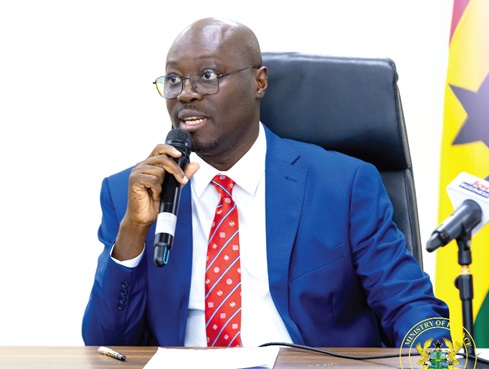
The Minister of Finance, Dr Cassiel Ato Forson, at a joint press conference with the IMF in Accra yesterday, said the technical assistance was one of the measures the government intended to leverage to ensure policy credibility and unlock the private sector to lead in job creation and solving youth unemployment.
He also stated that following the derailment of the IMF financial bailout programme at the end of 2024, the government in 2025 acted decisively to bring it back on track and to recalibrate it by implementing a frontloaded fiscal consolidation, bold expenditure rationalisation and strong structural reforms.
“These efforts have delivered tangible results: inflation has reduced significantly, the cedi has strengthened markedly, public debt as a share of Gross Domestic Product (GDP) has declined sharply, and economic growth has rebounded strongly,” he said.
Sovereign credit ratings
The minister said Ghana's sovereign credit ratings had improved significantly from restricted default (Junk Status) to 'B' with a positive outlook, representing five distinct rating levels upgrades.
He said that reflected improved fiscal performance, normalised creditor relations, stronger external buffers and renewed market confidence.
"Ghana's gross international reserves have risen to an all-time high, reaching approximately $14.5 billion by February 2026, almost six-months of import cover.
Dr Forson said the foreign exchange reserve buffers provided the country with the capacity to withstand external shocks and stand on its own feet.
Ghana ends
He said the announcement marked the definitive end of Ghana's financial bailout relationship with the IMF.
The finance minister expressed the government’s gratitude to the people of Ghana for their sacrifices, resilience and forbearance.
The government also expressed deep gratitude to its bilateral creditors, the Official Creditor Committee (OCC) and external and domestic investors for their collective sacrifice, Dr Forson said.
Ghana will engage
Going forward, the minister said Ghana would engage with the IMF through the PCI arrangement.
"It is a non-financing instrument designed to help countries implement economic reforms, signal commitment to policies, and unlock financing from private investors and other development partners.
"For the avoidance of doubt, the PCI does not provide financial bailout, but will offer continuous capacity development, confidence boost to the market, and deliver a catalytic effect for fresh financing to Ghana," he said.
Dr Forson added that the non-bailout PCI technical assistance would complement the government's efforts to achieve investment grade rating, which is to reach a Double B (BB) sovereign rating.
He said achieving investment grade rating would significantly lower sovereign and private sector borrowing costs, attract long-term institutional investors, increase foreign direct investment (FDI), and unlock cheaper financing for critical infrastructure development and private sector growth.
"Ultimately, this engagement will support government's effort to accelerate sustainable development, create jobs and raise living standards for all Ghanaians.
"President John Mahama and his administration remain fully committed to good governance, prudent economic management, fiscal discipline and creating an attractive environment for both domestic and international investment," he said.
IMF's position
The Division Chief of the African Department of the IMF, Ruben Atoyan, who led the Sixth and Final ECF Review Mission, said “Ghana’s ECF-supported programme has delivered substantial stabilisation gains.”
He added: “Inflation has declined rapidly, international reserves have been rebuilt, and confidence in the cedi has improved. Fiscal performance has strengthened markedly, with the primary surplus overperforming the programme target in 2025, while the public debt ratio declined sharply”.
Mr Atoyan said the country had also recorded a primary surplus and started reducing its debt-to-GDP ratio, in spite of the difficult economic conditions inherited under the programme.
He pointed to economic growth remaining strong, supported by broad-based private sector activity and recovery efforts, while progress in policy implementation and debt restructuring had marked an important turning point for the Ghanaian economy.
He explained that as macroeconomic stability continued to take hold, the IMF’s engagement with Ghana was shifting beyond crisis support towards sustaining reforms and building resilience.
“The IMF and Ghana have reached a staff-level agreement on a 36-month PCI, which signified the end of Ghana’s dependence on IMF financing,” Mr Atoyan stated.
He explained that the non-financing instrument would serve as a strong stamp of approval to signal to markets and development partners that policies were sound and reforms were on track.
The Mission Chief added that the new engagement would focus on growth-friendly fiscal consolidation, safeguarding debt sustainability, strengthening transparency and governance, and reinforcing monetary and financial policy frameworks to support inclusive growth and job creation.
Debt trajectory
Mr Atoyan said the improvement in Ghana’s debt trajectory had created fiscal space for government to address pressing development priorities, particularly employment opportunities for the youth.
He stressed that maintaining fiscal discipline and implementing stronger public financial management systems would be critical to sustaining the gains achieved under the programme.
“The overall objective going forward is to transform economic stability into stronger and more inclusive growth,” Mr Atoyan stated, and commended Ghana’s authorities for their strong engagement and commitment throughout the reform process.
