
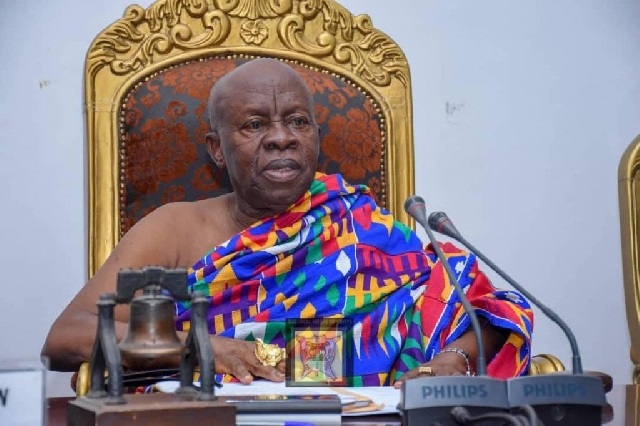
The National House of Chiefs has firmly rejected recommendations by the Constitutional Review Committee (CRC) proposing the merger of the Office of the Administrator of Stool Lands (OASL) with the Lands Commission, insisting that the institution must remain a separate and constitutionally protected body.
The House maintains that the OASL should continue to operate independently under the Ministry of Lands and Natural Resources, arguing that any attempt to merge it with the Lands Commission could undermine the management of customary land revenues.
In a statement issued by the Principal Registrar, Janet Naa Adjetey Adjeley, the House stressed that the OASL was established following sustained advocacy by traditional authorities during the drafting of the 1992 Constitution.
It noted that the office was created in response to concerns over poor accountability and management of stool land revenues under the then Lands Commission, adding that chiefs insisted on a dedicated structure to ensure proper administration of funds for development at the traditional level.
“Chiefs had always wanted their funds managed separately for the benefit of both traditional authorities and local development,” the statement read, adding that the OASL was not created solely as a revenue collection body but also to support the administration and management of stool and skin lands in line with Articles 267(7) and 267(8) of the 1992 Constitution.
Concerns over proposed merger
The House outlined several objections to the CRC’s proposal, warning that merging the two institutions could expose stool land revenues to financial risks due to the existing challenges within the Lands Commission.
It cited ongoing court cases and garnishee orders affecting the Lands Commission’s accounts, arguing that such legal and financial pressures could negatively impact the management of customary land funds.
The House also expressed concern about combining customary land administration with state land management, describing the two systems as fundamentally distinct in nature and function.
It further referenced the 2008 merger of land sector agencies under the Lands Commission Act (Act 767), describing it as a reform that failed to deliver the intended efficiency gains and instead worsened administrative bottlenecks.
According to the statement, prior to that restructuring, the Land Valuation Board operated in several districts, providing decentralised services that have since been curtailed.
The House also dismissed suggestions that the OASL and Lands Commission operate in isolation, pointing to existing legal provisions under Section 14 of the Land Act, 2020 (Act 1036) and Section 7 of the Lands Commission Act, which already require cooperation between the two institutions in customary land administration.
Call for strengthening OASL
Rather than a merger, the National House of Chiefs is urging government to strengthen the OASL by improving staffing levels through financial clearance and expanding its mandate beyond stool and skin lands.
It argued that since customary lands constitute about 80 per cent of Ghana’s landmass, they require a dedicated, well-resourced institution capable of ensuring efficient and accountable management.
The House reaffirmed its position that protecting the independence of the OASL is essential for safeguarding customary land revenues and ensuring equitable development across traditional jurisdictions.
