
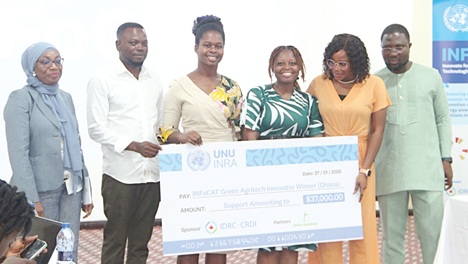
Stakeholders urge sustained support for clean agritech innovations
Stakeholders in Ghana’s agricultural and innovation ecosystem have called for sustained capacity building, local ownership and the responsible use of funding to ensure the success and scalability of clean agritech innovations aimed at promoting inclusive, low-carbon agricultural development.
The call was made at an event organised by the United Nations University Institute for Natural Resources in Africa (UNU-INRA) as part of efforts to promote green mechanisation, youth entrepreneurship and women’s participation in Ghana’s agricultural value chain.
The event, held on the theme: “Scaling clean agritech innovations for a just transition, inclusive, low-carbon agricultural development in Ghana”, brought together policymakers, development partners, innovators and technical experts to review outcomes of the INFoCAT Innovation Challenge.
Two Ghanaian innovators were awarded a total of US$37,000 to support the design, piloting and upscaling of clean agritech innovations.
At the event last Tuesday, the Project Coordinator at UNU-INRA, Ferdinand Tornyie, said the project, funded by IDRC Canada, was implemented in partnership with several institutions, including the Ministry of Food and Agriculture, Ministry of Energy, Ministry of Gender, Ministry of Employment, Youth Employment Agency and the Ghana Standards Authority (GSA).
Background, objectives
Mr Tornyie said the project was designed as a clean agritech innovation programme focused on promoting an inclusive green economic pathway towards a low-carbon economy.
He explained that the project combined clean energy, agriculture, green innovation, youth and women entrepreneurship, stating that it differed from traditional projects because it worked directly with entrepreneurs already operating in the market.
Mechanisation
Mr Tornyie said that although agriculture remained a major employer, particularly in the informal sector, it continued to face challenges such as low mechanisation and heavy dependence on fossil fuel-powered machines.
He said the project, therefore, focused on promoting green mechanisation that reduced emissions, supported off-grid communities, created green jobs and enhanced productivity.
The initiative, he said, aligned with Ghana’s national commitment to green transition and sustainable industrial development.
Project
Mr Tornyie explained that the project began with stakeholder engagement, field visits and baseline surveys to understand energy use dynamics within the agricultural value chain, particularly from a gender perspective.
He said women were found to occupy several roles across the value chain but were burdened with long working hours, manual processing, safety risks and unreliable energy access.
According to him, the challenges identified were converted into an innovation challenge for youth and women innovators.
Women-centred impact
Mr Tornyie said the piloted machines were deployed directly to women users, leading to significant time and labour savings.
He cited the example of a woman farmer who previously needed family labour and several days to process groundnuts but was able to complete the task alone within a short time using the new machine.
Gaps
Mr Tornyie revealed that the project identified gaps in women’s participation in core engineering roles, saying that as a result, 40 women from diverse educational and vocational backgrounds were selected for specialised hands-on training in machine fabrication, energy systems and innovation design.
Panel discussion
A panel discussion that followed provided a deeper interrogation of the policy, financing and institutional frameworks required to scale clean agritech innovations sustainably in Ghana.
Panel members drawn from government institutions, development partners, academia, and the private sector agreed that while innovation in the agritech space was growing, weak coordination between policymakers, innovators and end-users continued to slow adoption and scale-up.
