
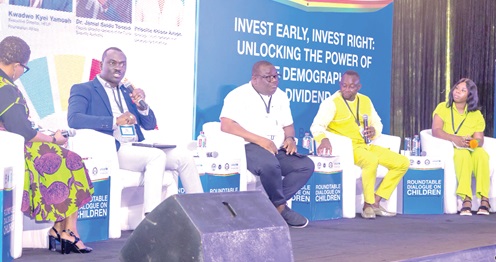
Strengthen child protection structures — Speakers
Speakers at a dialogue on children have urged government agencies, district assemblies and community leaders to strengthen child protection structures, improve law enforcement, and expand resources for social services to respond to climate and mining-related risks.
They warned that without such proactive measures, more children would be pushed into dangerous environments such as illegal mining sites, further undermining their safety, education and long-term well-being.
The speakers were the Regional Coordinator for Research and Action, West Africa Network for Peace Building, Kalie Sillah; Executive Director, HELP Foundation Africa, Kwadwo Kyei Yamoah; Deputy Director-General, Cyber Security Authority; Dr Jamal Seidu Tonzua, and Strategic Youth Network and Development in Africa, Priscilla Ahiada Adogo.
They were speaking on the topic: “De-coding emerging challenges confronting children in Ghana - social cohesion and vulnerabilities, galamsey, online child safety Climate Change”.
The meeting was organised by the Ministry of Gender, Children and Social Protection (MoGCSP) and UNICEF, on the theme: “Invest Early, Invest Right: Unlocking the Power of the Demographic Dividend”.
Climate change
Ms Adogo explained that extreme weather events, displacement, and weak enforcement systems were exposing thousands of children to exploitation, abuse and interrupted education.
She gave an example of how severe flooding in the Ashanti Region washed away an entire tomato farm, leaving families without income and children unable to attend school for days.
She added that in coastal areas, frequent erosion and flooding forced families to relocate to live with relatives, creating new risks for children, where some young girls suffered sexual abuse from male caregivers who withheld school fees, uniforms and food unless the children yielded to their demands.
Mr Yamoah cited poor reporting mechanisms, non-functional district child protection committees and widespread societal indifference as key drivers of child exploitation.
To buttress his point, Mr Sillah said children were becoming increasingly vulnerable in conflict zones such as Bawku.
Even more worrying, he said, was the growing trend of children becoming both victims and actors in conflict situations as armed groups and adults recruited children since they were seen as less suspicious.
Cybersecurity
Dr Tonzua, however, dismissed claims that the country’s child protection systems were weak, arguing that instead, the real challenge was in coordination with actors such as the central government, law enforcement agencies and human right institutions, among others.
He outlined some government-led initiatives aimed at strengthening online safety, including nationwide awareness campaigns on cyber hygiene practices and strict cybersecurity standards for institutions handling sensitive child data.
He said the Authority had also established a dedicated Child Online Protection Unit with a reporting line—292—for cases involving online harm.
Collaboration
In a speech read on her behalf, the Minister of Gender, Dr Naa Momo Lartey, called for multi-sectoral collaboration among government, civil society, development partners, academia, the private sector and families to improve the well-being of children.
The Chief, Social Policy and Inclusion, UNICEF, Paulina Mulhovo, said the dialogue was to support the Gender Ministry, the Ghana Statistical Service, and the NDPC to develop an evidence-based analysis of the situation of children in Ghana.
She noted that UNICEF and the government were working together to ensure policies were data-driven.
