

Yendi: Home of rich tradition, untapped tourism potential
With the mention of Yendi, what usually comes to mind is its revered status as the traditional capital of the Dagbon Kingdom and the seat of the Overlord, the Ya-Na.
In fact, the name of the town commands respect, evokes imagery of royalty, ancient customs and the kind of authority that has survived wars, conflicts, transitions and held Dagbon together for centuries.
With a population of about 154,421 per the 2021 Population and Housing Census, Yendi is about two hours’ drive from Tamale, the Northern regional capital.
Beyond its traditional relevance, the town is endowed with numerous untapped scenic tourist sites, ranging from landmarks and hospitality to diverse cultures, putting the area on the tourism map in the country.
On a daily basis, researchers, students and tourists from home and abroad visit the ancient town to savour the taste of the sites. All the sites, however, await investment to tap their full tourism potential.
German Cemetery
In the heart of the town lies the German Cemetery, the resting place of some colonial soldiers killed during the 1896 battle with Dagbon warriors.
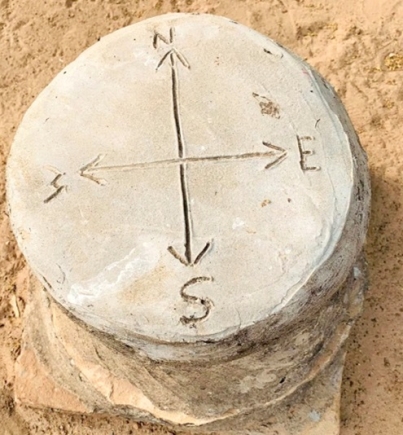
The Greenwich Meridian line situated at Yendi
The German colonial soldiers had launched an aggressive military attack against the Dagbon Kingdom to conquer and colonise the area, but that move was fiercely resisted by the warriors of Dagbon.
After conquering them, the graveyard was allocated for their burial to serve as a symbol of remembrance in the history of the kingdom.
History has it that, around 1890, the Dagbon Kingdom was threatened by Europeans from all directions – from the south by the Germans, from the west by the British and from the north by the French.
This was to ostensibly colonise the area, but Dagbon resisted colonialism for several years.
The German forces had established their base at Adibo, a suburb of the Yendi Municipality, where they were mapping out strategies to conquer the area.
Following their resistance against foreign authority, on December 3, 1896, the people of Dagbon also known as Dagbamba, met and launched an attack on the heavily armed German Schutztruppe and Askari paramilitary police accompanying the leader of the German Forces, Lieutenant Valentin von Massow, who had been sent by the German colonial administration to quell the rebellion and was on his way to their capital at the village of Adibo.
History has it that the Dagbamba fighters suffered significant losses on the second day of the battle and after, their capital, Yendi, including the Gbewaa Palace, which is the seat of the King of Dagbon, was razed to the ground.
That enabled the German Empire to complete establishing the Togoland protectorate, which encompassed the eastern part of the Kingdom of Dagbon.
According to folklore, traces of the war are still very visible at the specific place of the battle at the Adibo community, where the Germans first came into contact with the Dagbamba forces.
Despite the interesting story behind the site, it is in a deplorable state as it has not seen any development over the years.
The cemetery, which is lying bare in the middle of the town, is being encroached upon by some private developers and individuals.
According to the Chief Executive of the German Heritage Foundation, Sulemana Alhassan, the German Cemetery is revered and an important site in the history of the kingdom.
He said the cemetery was under serious threat because no attention was paid to it, adding that when properly developed, it could boost domestic tourism and rake in revenue to the government.
“Despite its current state, a lot of foreigners, particularly Germans, visit the place to get a feel of it.
However, it is very worrying that the place is being encroached upon by some residents; you can clearly see that some people are farming at the edges of it.
If nothing is done about it, in the next few years, I know everything will be gone,” he lamented.
Mythic Baobab
Another extraordinary site is the Naa Binbiegu Tua, named after Ya-Na Zangina Zuu Jinjli (1687–1700), who was considered the most unattractive Ya-Na in Dagbon history. The 332-year-old tree was used for sacrifices and rituals connected to the kingdom’s leadership.
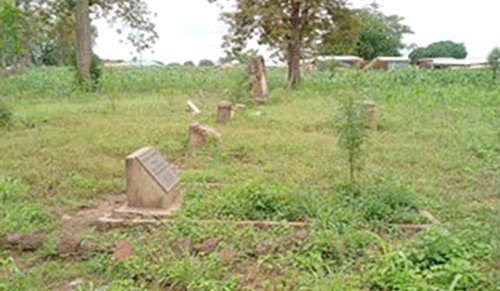
The German Cemetery which is being encroached upon by developers
History has it that the motive behind the name of the tree was due to the unattractive nature of the chief and his struggle to ascend to the Dagbon throne.
As the eldest son of Naa Zangina, a former Overlord of Dagbon, he was expected to be the regent after the demise of his father to oversee the performance of his funeral.
After the demise of his father, Naa Binbiegu consulted the elders of Dagbon and family members to perform the funeral rites of his late father.
However, he was not considered for the chieftaincy role after serving as the regent of Dagbon due to his supposed ugliness. A new Overlord, Naa Andani Sigli, was installed.
According to historians, when Naa Andani Sigli passed on, people started teasing Naa Binbiegu, asking him to put on the chieftaincy regalia and crown himself as the Ya-Na.
He was forcefully adorned with the chieftaincy regalia by the princesses who sang tunes of Damba and he danced back and forth, finally moving into the Gbewa Palace.
The chief drummers sang appellations to Naa Binbiegu, such as “Naa Binbiegu Yi polo ku lahi sogu”, which literally means, your ugliness has come to light and can no longer hide.
This event on that day signified the installation of Naa Binbiegu as the next Ya-Na and the predecessor of Naa Andani Sigli. His reign lasted for 13 years.
Tourists site
The giant baobab tree has since been preserved as sacred for its cultural and historical importance. However, the site has not been developed to tap its full tourism potential.
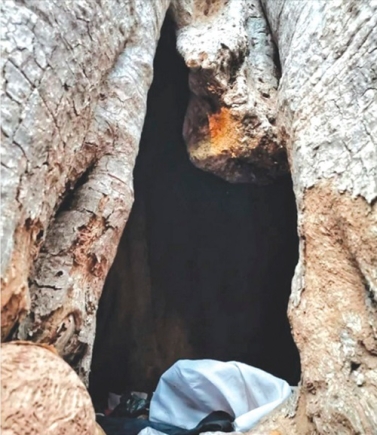
The deep hole in the Naa Dataa Tua where human heads were thrown into
Currently, the tree, situated in the heart of the town, has been left bare with not even a signpost mounted for easy identification.
Instead, under its giant branches, shops are being put up. It is difficult for one to distinguish it from other wild baobab trees.
Narrating the history, a Traditional Historian, Yakubu Zakaria Tia, said the tree symbolises the struggle of Naa Binbiegu to ascend the Dagbon skin as the overlord.
He said history had it that it was due to his unattractive looks that he was not compensated with any chieftaincy role after serving as the Regent of Dagbon, which was a normal traditional practice.
“In the history of Dagbon, he is the only regent who has not been compensated before with any title,” he said.
He added that "Naa Binbiegu’s story is about resilience. Despite being denied recognition for his appearance, he became a king.
This tree is sacred and historically important, but sadly, it remains underdeveloped and lacks protection”.
Aside from its rich cultural relevance, the tree also serves as a sacred ground for people to offer sacrifices and prayers.
A resident, Alhassan Fuseini, said he had once offered prayers at the tree and all his wishes were granted.
Another resident, Mustapha Ibrahim, urged authorities to preserve the tree as it holds enormous historical and cultural value.
The King’s Rival Tree
Another intriguing site is the Naa Dataa Tua, an ancient baobab where men who committed adultery with the Ya-Na’s wives were historically executed.
The hollowed trunk of the tree once held the heads of the culprits, while their bodies were disposed of in a nearby valley.
According to historians, some linguists and individuals used to have amorous relationships with some of the Ya-Na's wives, which is forbidden in the Dagbon tradition.
To deter people from engaging in such acts, anyone found culpable was beheaded.
It is said that their necks were placed on an oval-shaped laterite rock and their heads cut off and thrown into a hole in the baobab tree, while their bodies were disposed of in a valley.
The tree, which has been preserved as a sacred monument and a tourist attraction, is very huge, with a big hole in it.
Few metres away from it are the oval-shaped laterite rocks where victims were placed and beheaded.
Though the site has not been developed, the baobab tree and the rock have been preserved for their cultural significance.
A Historian, Abdulai Mohammed Mutala, explained that the executions were meant to protect the royal family and uphold tradition.
He indicated that while human executions have since stopped, the baobab remained sacred, adding that if developed, it could become a major tourist attraction.
Other attractions
Aside from the above sites, there are notable untapped tourists’ sites including the Greenwich Meridian, Gbewa Palace, Adibo Nemohi Tua and Kambo Naakpem Ziblim Grave —each carrying layers of untold history of Dagbon.
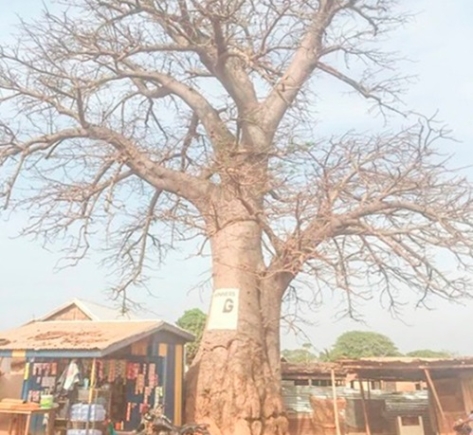
The 332-year-old sacred mythic baobab tree
Yendi is also one of the few places where you can still witness traditional blacksmithing, smock-weaving, indigenous pottery making, and royal regalia crafting done the same way it was a century ago.
These crafts are not museum pieces, but they are part of the community’s daily rhythm, which offers visitors rare and close-up experiences.
Development
In an interview with the Daily Graphic, the Northern Regional Manager of the Ghana Tourism Authority, Angelo Dogbe, indicated that the authority was working closely with relevant bodies to help develop the sites across the region.
Specifically, in Yendi, he said the authority had completed concept designs for the development of the sites such as the Adibo Cemetery, Greenwich Meridian and German Cemetery, as part of efforts to position the ancient town as a cultural tourism destination.
He added that Memorandums of Understanding (MOUs) had also been signed with traditional leaders and district assemblies for key heritage sites, including the Gushegu Smock Village and the Sakpuli Slave Wells.
Way forward
Tourism is one of the main drivers of the nation’s economy as it contributes averagely US$1.9 billion to the country's Gross Domestic Product.
According to GTA, the country welcomed over 1.2 million international visitors and generated nearly US$4.8 billion in tourism revenue in 2024 alone.
While much of that growth has been concentrated around coastal heritage sites and major festivals, towns such as Yendi which is rich in history but low on investment remained largely outside the main tourism circuits.
It is, therefore, important for the government to pay much attention to underdeveloped areas such as Yendi to help boost the tourism industry and accelerate national development.
Writer’s email:
