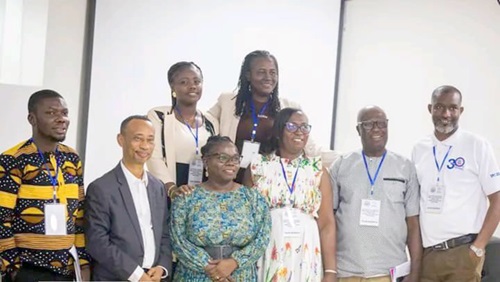
UEW, UNESCO forge partnership against misinformation
The University of Education, Winneba (UEW), has adopted the UNESCO Media and Information Literacy (MIL) curriculum to tackle online misinformation and disinformation through Ghana’s education system.
The initiative will adapt UNESCO’s global MIL framework to Ghana’s context to ensure that teachers and students in all sectors of education have the competencies needed to consume and produce information responsibly.
It would pilot the adapted curriculum in UEW before scaling it nationally.
Speaking at the project’s inception meeting in Winneba on Tuesday, the Project Lead, Prof. Gifty Appiah Adjei, explained that the integration of MIL into teacher education was a strategic response to addressing information disorder in Ghana.
“Thanks to technological advancement, seeing is no longer believing, because people can fabricate, manipulate and manufacture information. One of our aims is to help build students’ and teachers’ capacities to navigate online safely,” she said.
Requirement
For his part, the Programme Specialist at UNESCO, Abdul Hamid Yakubu, urged UEW to lead in making MIL competencies mandatory in teacher certification and professional development.
He also stressed that media and information literacy lie at the core of the human right to freedom of expression.
UNESCO views MIL as a fundamental right enshrined in Article 19 of the Universal Declaration of Human Rights.
Thus, UEW should take steps to make MIL competencies a requirement for educators across all subjects, not only media or IT,” he said.
Mr Yakubu further called for lifelong learning initiatives and public campaigns that would help citizens critically evaluate information and strengthen democratic participation.
Collaboration
The Director for Curriculum at the National Council for Curriculum and Assessment (NaCCA), Reginald George Quartey, pledged his institution’s collaboration with UEW to deepen the integration of MIL into Ghana’s curriculum.
He said NaCCA had already embedded aspects of media and digital literacy across various subjects, including history, mathematics and information and communication technology.
Mr Quartey explained that “media information literacy is not a standalone issue, but a fusion of information literacy, media literacy and digital literacy.”
He added that the Council had developed a Teacher Resource Pack and Training Guide to support educators in implementing these competencies effectively.
Partnership
A Ghana Education Service (GES) representative, Isaac Yeboah, commended UEW and UNESCO for the partnership, describing the project as timely and aligned with Ghana’s national education strategy.