

We’re committed to ensuring high-quality education — Vice-President
The Vice-President, Professor Naana Jane Opoku-Agyemang, has said the government is committed to ensuring high-quality education in the country.
She said that in line with this, some interventions were being implemented to facilitate effective teaching, research and learning in institutions.
Prof. Opoku-Agyemang was speaking at the 59th Congregation of the Kwame Nkrumah University of Science and Technology (KNUST) in Kumasi, Ashanti Region.
Present were the Asantehene, Otumfuo Osei Tutu II; the Chairman of the Governing Council, Akyamfuor Asafo Boakye Agyemang-Bonsu, and the Vice-Chancellor of the university, Prof. Rita Akosua Dickson.
They jointly inaugurated six projects to boost teaching and learning at the university. They were a multipurpose laboratory, a bottling factory and the Institute of Rural Development and Innovation Studies (IRDIS).
The rest were an Agri-Impact greenhouse, a children’s park — a child-friendly recreational facility — and a souvenir shop.
Prof. Opoku-Agyemang also said the government had introduced some initiatives to make education accessible to all.
She mentioned the recently launched Free Tertiary Education for Persons with Disabilities (PWD) by President John Dramani Mahama as one of the interventions.
Under the programme, students with certified disabilities admitted to accredited public tertiary institutions would have their tuition and academic facility fees absorbed by the state.
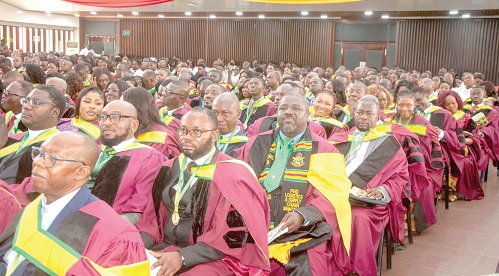
The KNUST congregation in Kumasi
The system is being administered through a mechanism designed to ensure efficiency and transparency.
The Vice-President described it as a social reform that ensures inclusivity by removing structural barriers to enable every learner to participate meaningfully in the nation’s development process.
On the No Fees Stress policy for first-year public university students, she said the intervention had eased the transition into tertiary institutions for hundreds of young people, adding that “the policy has removed one of the steepest obstacles at the point of entry for more than 120,000 students who have benefited from the new reimbursement structure”.
“This is an equity-driven intervention designed to ensure that admission to our tertiary institutions is determined as much as possible by merit and also by aspiration,” Prof. Opoku-Agyemang said.
Expectations
The Vice-President reminded the students that a higher degree was a qualification, as well as an expectation, saying “the expectation is that you will lead enquiry, elevate discourse and apply your intellect to complex problems”.
“The Ghanaian public and indeed the African continent needs thought leadership grounded in resourcefulness, data, ethics and public value,” she added.
Prof. Opoku-Agyemang said that whether they remained in academia, public service, business, or engaged in international diplomacy, their ability to think clearly and act responsibly would be tested.
She further said that the real value of their degree might not be evident today but would be seen over time in institutions they strengthened, the young people they would mentor and the policies they would help refine, among others.
While congratulating them for the successful completion of their respective disciplines, Prof. Opoku-Agyemang said, “As a nation, we look to you not necessarily for easy answers but for better questions, sharper tools and deeper insights”.
For his part, the Asantehene lauded the management of the university for their commitment to the development and advancement of the institution for the benefit of the citizenry.
Writer’s email:
