
Africa’s ruling political parties
Political parties play an important role in a democracy.
In addition to serving as the organising force around which elections are contested, they provide avenues for citizen engagement in democratic spaces.
As ruling parties, they form governments with the responsibility of implementing policies and programmes to help address public problems.
As opposition parties, they help to hold the government in power accountable, including offering alternative solutions to public problems.
A look across the continent and how some ruling parties are behaving in electoral contests is worrying. It is even more worrying because elections are one of the key practices at the heart of democracy, and should these behaviours continue, the only question left to ask is what will happen to democracy on the continent?
Worrying signs
Take Uganda, for example, as it prepares for presidential elections on January 15, 2026.
The images of what appears to be state-sponsored violence targeted at the main opposition raise concerns about electoral integrity and the determination of a ruling party and its candidate to further entrench themselves in power.
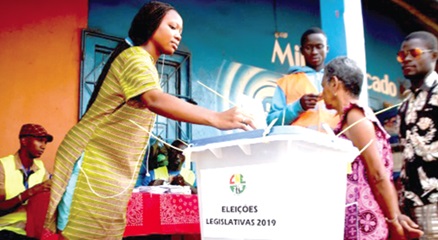
Or consider the case of Guinea-Bissau and the recent military takeover as the country awaited the declaration of election results, which reports suggested the main opposition candidate was likely to win.
It is now being rumoured that the ruling party and incumbent president, unwilling to cede power to the opposition, orchestrated the military takeover.
This narrative has gained more traction, with the appointment of the finance minister in his government as the prime minister in the current military government.
Then there is Cameroon’s Paul Biya, who won re-election and secured an 8th presidential term.
We cannot forget the case of Alassane Ouattara (Côte d’Ivoire), who won re-election to serve his fourth presidential term, and Samia Suluhu Hassan (Tanzania), whose own re-election raised electoral integrity issues, not forgetting the poor treatment of opposition candidates.
In all these countries, trust in the ruling party, as of the most recent Afrobarometer (Round 10, 2024), is low in countries like Uganda (31 per cent), Cote D’Ivoire (26 per cent), and Cameroon (Eight per cent). Guinea-Bissau did not participate in the survey.
Interestingly, in Tanzania, 62 per cent expressed “a lot” of trust in the ruling party. I am curious to see what the response will look like in Round 11 of the survey, given what has transpired this year.
In the examples above, entrenchment in power appears to be the goal. It is as if those pursuing this goal believe that if it must come at the expense of weakening the core principles of democracy, it is the price citizens must pay.
Hopeful signals
In fairness, not all ruling parties have exhibited concerning behaviours in terms of attempting to entrench themselves in power.
In Ghana, since the return to multiparty democracy, ruling parties have conceded electoral defeat to their main opposition rivals in four elections (2000, 2008, 2016, and 2024), out of a total of nine held so far.
It must also be said that these ruling parties have made no attempt to engage in what I call constitutional fidgeting to manipulate, especially term limits, as a way of entrenching themselves in power.
Strangely, trust in ruling parties has declined significantly over the years from 41 per cent (Afrobarometer Round 2, 2002) to 10 per cent (Afrobarometer Round 10, 2024).
In 2024, there were other ruling parties that lost and accepted the election outcomes.
In Botswana, the ruling party lost an election for the first time in 60 years after independence. Granted, it came at a time when citizens in the Afrobarometer survey conducted in the country were expressing very serious pinch points about economic conditions and democracy overall.
Credit also goes to countries such as Mauritius, Malawi, and Senegal, where elections this year saw ruling parties lose and concede defeat, ensuring that their respective democracies were not put at risk.
But again, trust in ruling parties (Afrobarometer Round 10, 2024) is low in these countries – Botswana (10 per cent); Mauritius (Nine per cent); and Malawi (13 per cent).
It was better in Senegal, where 40 per cent of citizens expressed trust in the ruling party.
Overall, these cases illustrate the divergent ways in which ruling political parties have been conducting themselves on the continent.
Lessons for the future
The mixed behaviour of ruling parties and the generally low trust expressed in ruling parties present political parties with an opportunity to reflect on how they can serve as defenders of democracy on the continent and not as drivers of democratic erosion.
The burden, though, is not only on ruling parties because the low level of trust expressed in them is also expressed in opposition political parties.
It is, therefore, a general wake-up call for political parties to do better.
Africans have not given up yet on political parties as a strong majority (69 per cent) say “more parties are needed so citizens have a choice in who governs them (Afrobarometer Round 10, 2024).
The writer is the Project Director, Democracy Project.
