
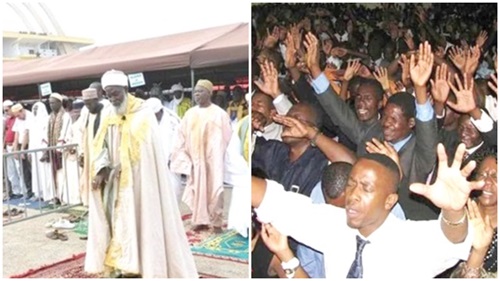
Ensuring religious peace and harmony in Ghana
The controversy concerning what rights the Christian authorities of Wesley Girls’ Senior High School (SHS) have, and what the school’s Muslim students should enjoy in this regard, is a hot topic.
Ghana has a high degree of religiosity and the controversy surrounding the Wesley Girls’ SHS issue has generated much debate.
This article assesses how Ghana fares among African countries in terms of defending religious freedom and what more needs to be done.
Religious freedom
Ghana is prominent among sub-Saharan African countries for its strong, actively protected, constitutional guarantee of secularism and religious freedom.
Despite this, some feel that religious minorities in the country, including Muslims and followers of African Traditional Religions, face practical challenges which followers of the majority religion, Christianity, do not.
Unlike countries where religion is deeply intertwined with the state or where religious majorities face severe discrimination, successive governments in Ghana have sought to assert their neutrality when navigating the diverse religious landscape.
Some of Ghana’s neighbours have comparatively less religious freedom, and part of the reason is that the country’s legal framework is supportive, although practical implementation can be complex.
A recent co-authored article of mine which appeared in the journal, The Review of Faith & International Affairs (https://www.tandfonline.com/doi/full/10.1080/15570274.2025.2543621?src=), found that governments in sub-Saharan Africa are becoming more involved in religion via increasing levels of support and regulation of the majority religion as well as in relation to discrimination against religious minorities.
Societal discrimination against religious minorities is increasing. =
This pattern is consistent across regional Christian-majority and Muslim-majority countries, but all of these phenomena are more common, on average, in the region’s -majority countries.
These changes are significant given that previous studies focusing on 1990–2014 found the region to have among the lowest levels of both discrimination and government support for religion globally.
The 1990s was an era of democratisation in sub-Saharan Africa. Ghana was among a number of African countries democratising at this time, a period when the Church was prominent in calls for political reforms, including in relation to democracy, human rights and religious freedom.
My 1996 book, Religion and Politics in Africa, provides a study of the interaction of religion and politics in Africa from the colonial era to democratisation in the 1990s, locating the issue of religious freedom in Ghana in relation to the travails of imperialism, post-imperialism and the attempt, begun by Kwame Nkrumah and continued by successive governments, to develop a viable post-colonial nation state.
Recent research indicates that many African governments seek to regulate religious practice in both legitimate and illegitimate ways.
Certain religious groups may be disproportionately affected by these measures.
The state’s involvement with religion in Africa can lead to abuses of related rights and freedoms, including in relation to women’s and ethnic minorities’ rights and the right to political participation, expression, and association.
Ghana is not among these countries, and the country has hitherto an exemplary record of religious harmony.
This is not the case among some of Ghana’s neighbours.
The USA-based Nigerian sociologist, Ebenezer Obadare, has extensively studied the relationship between state and religion in Nigeria and finds that the country has long been plagued by religious divisions.
After the restoration of democracy in 1999, tensions between Christians and Muslims intensified.
The de facto division between Nigeria’s mainly Christian south and mostly Muslim north is today central to the country’s electoral politics and to the relationship between state and religion.
Religious peace and harmony
Ghana is not currently threatened by the kind of religious division seen in Nigeria.
Those involved in governance in Ghana – that is, the government, the wider state, representative religious organisations and wider civil society – would no doubt agree that Ghana’s religious peace and harmony are priceless and must be protected.
How can this be assured in an increasingly volatile environment, with massive socio-economic and cultural changes occurring with great speed?
To ensure continued religious harmony and peace, governance in Ghana must offer a holistic vision of citizenship to emphasise both legal equality and neighbourly solidarity.
A constitutional order characterised by equal rights and responsibilities is essential, as is a culture of engagement marked by relationships of mutual respect and protection.
Both state and society must work together.
Government must ensure continued freedom of religion and belief. Society needs to show more than mere tolerance – religious harmony also requires religious literacy, both of one’s own religion and of one’s neighbours’ religions.
Finally, what is also necessary is both sustained practice and consistent cultivation of societal character traits to develop further robust, sustained engagement between people of different religions and/or worldviews.
This is not ‘pie in the sky’: it is a practical necessity for Ghana, both fervently religious and religiously diverse.
How to develop such an approach to religious harmony and understanding?
Parents, schools, the church and the mosque should work together to develop societal tolerance further so that religious differences do not lead to more societal discrimination.
This would enable Ghana to continue to enjoy the religious peace and harmony which sets the country apart from many of its neighbours and which enables the world to view Ghana as that rare African success story, where religious difference is a strength encouraging national development.
The issue of the Wesley Girls’ SHS and its approach to religious difference offers a good opportunity to debate, discuss and thrash out a way forward.
The issue is too important and potentially dangerous to be ignored.
The writer is an Emeritus Professor of Politics, London Metropolitan University, UK
