
Let’s kill gold mentality as only major means of living - Asare Donkor rallies nation
Broadcast Journalist and Environmental Advocate, Erastus Asare Donkor, has rallied the nation to abandon the long-held belief that gold is the only major pathway to livelihoods, as part of the broader fight against illegal mining (galamsey).
He said the country’s struggle against environmental destruction required not just enforcement reforms but a deeper collective mindset shift that freed communities from economic dependency on unsafe and destructive mining practices.
“It is also important to note that we cannot enforce without empathy.
The fight against galamsey must go hand in hand with alternative livelihood programmes. People need something to live for and live on.
We must invest in skills, agriculture, eco-tourism, and local enterprise. Otherwise, we will only be pushing poverty from one pit to another,” he said.
Mr Donkor made the call last Thursday, at the 20th Kronti ne Akwamu public lecture organised by the Ghana Centre for Democratic Development (CDD-Ghana).
Lecture
Kronti ne Akwamu is the centre’s flagship annual public lecture on democracy and governance.
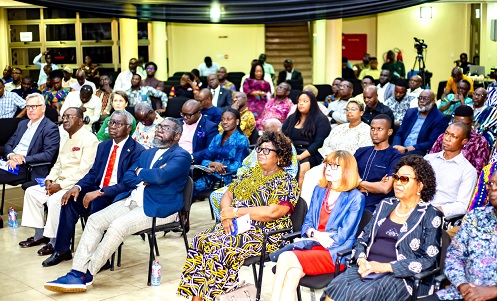
It is aimed to bridge the gap between reflection, research and analysis on one hand, and pro-democracy and good governance advocacy on the other.
This year’s edition was on the theme, “Galamsey: A Country’s Search for a Solution in Plain Sight,” and it brought together government officials, security agencies representatives, civil society organisations, the diplomatic community, researchers, academia and industry players, among others.
The crisis
Mr Donkor, who is currently an Assistant News Editor with the Multimedia Group Limited, lamented that the galamsey crisis extended far beyond forest loss, warning that major rivers such as the Pra, Offin, Ankobra, Birim and Tano were heavily polluted with toxic metals, in some cases more than twice the WHO safety limits.
He also mentioned the severe air contamination in mining communities, where mercury is openly burnt, with concentrations in places such as Talensi, reaching levels far above international safety thresholds.
These exposures, he said, were translating into alarming health outcomes, including rising birth defects in galamsey-affected districts, with two-thirds of recent cases traced to mothers living in or around mining zones.
Reforms
Mr Donkor called on the government to urgently upgrade the Forestry Commission.
“It must be retooled and monitored to prevent the open looting of our forest reserves, often in the name of reclamation.
The Forestry Commission must be upgraded to a para-military status, trained to properly demarcate and man the forest frontiers of our country,” he said.
Mr Donkor also urged the Minerals Commission to operationalise an excavator-tracking system to prevent the mysterious “disappearance and reappearance” of machinery in mining zones.
Additionally, he called for water bodies and key biodiversity corridors to be declared national security zones, enforced by a decentralised and well-resourced National Anti-Illegal Mining Operations Secretariat (NAIMOS) without political interference.
“Let's kill the gold mentality as the only major means of living.
Let's revive the NCCE and let it play its vital role of educating on the effects of galamsey.
What we lack is not strategy; it is political will and moral courage,” he said.
While advocating for the reclamation of degraded lands and desilting of rivers to restore ecological balance, Mr Donkor stressed that MMDCEs should be held accountable for nature crimes within their jurisdictions.
“Galamsey is not just an environmental crisis. It is a test of leadership, of governance and of conscience.
If we fail this test, our rivers will carry the memory of our silence. Our forests will not forgive us,” he added.
