
The re-emergence of Pan-Africanism as a global force and reparative justice
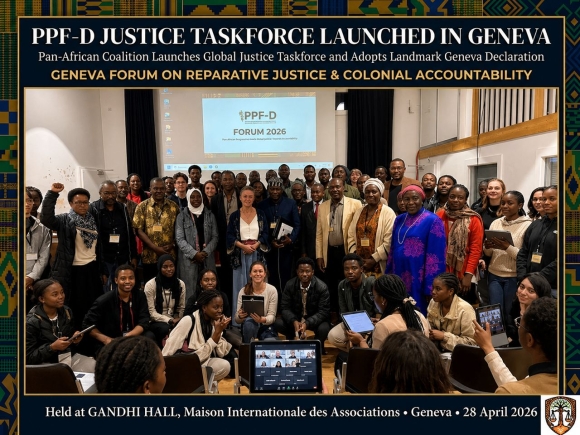
Continental and diaspora leaders assembled at the Maison Internationale des Associations to transform United Nations recognitions into functional legal systems. The Pan-African Progressive Front collaborated with the Ligue Panafricaine–UMOJA and the Université Populaire Africaine en Suisse to conclude the Geneva Forum on Reparative Justice and Colonial Accountability on April 28th, 2026 in Geneva.
Delegates officially ratified the Geneva Declaration on Reparative Justice to establish a binding moral and political framework for future negotiations. The forum marked the formal launch of the PPF-D Justice Taskforce on reparations to oversee specialized operations in legal strategy and public advocacy and presented the 12-Month Advocacy Calendar and the Reparations Advocacy Manual & Toolkit.
During sessions, Comrade Kwesi Pratt Jnr, a speaker at the forum provided a masterful historical framing that served as the intellectual backbone for the forum's legal deliberations. This framing established a direct link between historical theft and the current economic disparities facing African nations and their diaspora. The forum successfully moved the needle from passive observation to the active pursuit of concrete reparative frameworks.
“This is the economy which was built on the back of classical colonialism. After the time has come, it has to reflect the situation. The time has come for the Africans, who grew up because of the wealth, to build a system which will give us wealth, first and foremost, to own the resources, to exploit resources for the benefit of the people. This is the clarion call for reshaping of the world. This is the clarion call for resetting of the world. First, this is the clarion call for reparation. This is the clarion call for a new world in which no child will go to bed in the hands of the one”, Pratt ended.
The establishment of the PPF-D Justice Taskforce on reparations creates a permanent coordinating body to oversee the implementation of the Geneva Declaration on Reparative Justice. This body will function as a central hub for legal experts and historians to collaborate on litigation strategies that target systemic injustice. The participants emphasized that the time for pleading has passed and the era of organized, legal demand has arrived. The international community must now prepare for a sustained campaign designed to rectify centuries of exploitation through the rule of law.
Brice Nitcheu, President of Foundation Moumie, United Kingdom, during his submission on ‘Strategy, Action Planning and Toolkit Launch’ wrote to all, saying; “When a people, a continent, or a diaspora imposes its memory in the global public sphere, it is not simply demanding that its suffering be remembered; He also challenges the historical distribution of narrative power. He refuses to allow the center to continue speaking for the periphery. He refuses to allow victims to be condemned to depend on others for the intelligibility of their own history. The slave trade and the enslavement of Africans were not simply mass acts of violence among others. They constituted a global system of deportation, commodification of the Black body, extraction of wealth, destruction of social continuities, and racial hierarchization of the world. Their gravity is therefore measured not only by the scale of the suffering inflicted, but also by the structural depth of their effects. We are talking here about a crime that contributed to the accumulation of wealth in certain parts of the world, while simultaneously contributing to the disintegration of African societies and the production of long-standing historical inequalities. Therefore, memory is not a mere embellishment. It is an act of truth. It is an act of reappropriation. It is a condition of dignity. Without memory, there is no stable historical truth; without truth, there is no responsibility; and without responsibility, there is no justice. But a memory reduced to mere ceremony remains insufficient. This is where the heart of my argument begins.”
The speech was essential, both from the perspective of history and that of international relations.
Significantly, from Sierra Leone, was His Excellency Samuel Sam-Sumana who delivered a powerful keynote address emphasizing a shift from mourning past tragedies to organizing for a sovereign future.
His Excellency’s speech read, “Africa cannot lead this movement from inside the Treasury operations account of a foreign country. Africa cannot lead this movement while signing trade arrangements that her own economists describe in private as colonial. Africa cannot lead this movement and at the same time auction her strategic minerals to whichever bidder arrives first with a briefcase and a flight back to Europe within the week.”
“If we want the world to take African reparations seriously, then African governments must take African sovereignty seriously. The two are inseparable. You cannot demand respect for the African past while accepting disrespect for the African present”, H.E added.
“The main outcome of the Geneva Forum is that, for the first time in history, concrete steps have been presented towards the restoration of reparative justice. Together with the Pan-African Progressive Front (PPF) and partners from the diaspora, we are moving from statements to action” — declared Simeone Azoska, Head of the PPF Secretariat.
He again urged the youth at the conference, both in person and virtually, to know that they are not late to the struggle. “You are not late. You are exactly on time.”
A dedicated digital platform at (https://pp-front.com) hosts the newly launched resources on reparative justice to facilitate decentralized activism across various time zones.
