
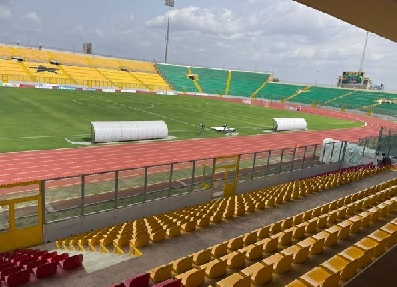
Eric Tinkler’s recent criticism of the Baba Yara Sports Stadium pitch should not be dismissed as the complaint of an expatriate coach unfamiliar with Ghanaian conditions.
It is another warning that the country’s persistent failure to maintain its major sporting facilities is damaging the quality of domestic football and threatening Ghana’s ability to host international matches.
The Asante Kotoko coach raised legitimate concerns after his side defeated Hearts of Oak 4-1 on penalties following a goalless Democracy Cup contest.
The poor surface restricted quality football and again exposed weaknesses that the Ministry of Sports and Recreation and the National Sports Authority (NSA) have allowed to become chronic.
It was therefore disappointing that experienced Ghanaian coaches Maxwell Konadu and Abdul Karim Zito responded by urging Tinkler to adapt.
Poor pitches are not an unavoidable feature of Ghanaian football. They are evidence of institutional failure. Normalising them lowers professional standards and weakens the case for investment in the domestic game.
The Confederation of African Football (CAF) will not accept “adaptation” as an answer when inspecting venues for the 2027 Africa Cup of Nations qualifiers.
Ghana risks losing the right to stage Black Stars matches if pitches in Kumasi, Accra and Cape Coast fail CAF’s technical and safety requirements. The humiliation and financial cost of playing home fixtures abroad would be considerable.
The NSA says the Baba Yara Stadium pitch will be fully matured before Kotoko’s opening Ghana Premier League home match against Heart of Lions on September 13. It has attributed the present condition partly to the late relocation of the Democracy Cup from Legon to Kumasi.
That explanation may provide context, but it does not resolve the wider crisis.
Even more disturbing is the condition of the Accra Sports Stadium. After inspecting the facility, NSA Board Chairman, Professor Fred Awaah, described sections of it as a “death trap” and warned of a possible catastrophe. Berekum West MP, Dickson Kyere-Duah, who is a member of the Parliamentary Sub-Committee on Sports, similarly argued that CAF had been charitable in continuing to approve Ghanaian venues.
These are extraordinary admissions. A facility rebuilt for the 2008 Africa Cup of Nations and refurbished again before the 2018 Women’s Africa Cup of Nations should not be attracting warnings about collapse.
If the stadium is structurally unsafe, it must not be filled with spectators while officials debate another temporary repair.
Ghana has invested millions of dollars in sporting infrastructure, yet maintenance remains reactive, underfunded and dependent on major tournaments.
The deeper problem is structural. Our stadiums were not developed as modern commercial assets capable of generating substantial income throughout the year.
The NSA has also failed to maximise opportunities in naming rights, hospitality, retail, advertising, conferences, entertainment and other non-matchday activities. It consequently relies on inadequate internally generated funds and irregular state support to maintain costly facilities.
The Ministry of Recreation and Sports, headed by Kofi Iddi Adams, and the Yaw Ampofo Ankrah-led NSA must now produce audited safety assessments, costed rehabilitation plans, enforceable maintenance schedules and credible commercial strategies for every major stadium.
Pitch management must be entrusted to qualified specialists and protected from political interference and indiscriminate use.
Inspections and assurances are no longer enough. Ghana must decide whether its stadiums are national assets to be professionally managed or monuments to neglect awaiting the next emergency.
The authorities must sit up before CAF sanctions—or a preventable tragedy—forces them to act.
