
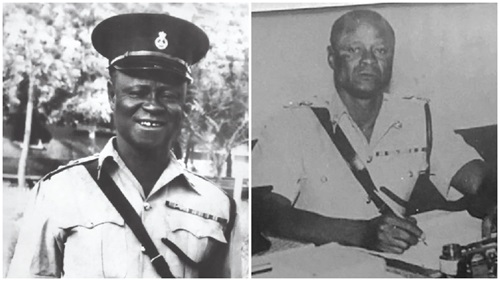
On February 28, 1948, then Inspector Issa Kanjarga of the Gold Coast Police Force prevented the mass murder of veterans who were marching to the Christianburg Castle to present a petition to the governor of the Gold Coast, Sir Gerald Creasy.
Inspector Issa Kanjarga was the second in command after Major (Superintendent) Colin Imray, the infamous British colonial police officer who snatched the rifle of one of the police men and shot Sergeant Adjetey, Corporal Attipoe and Private Odartey Lamptey dead.
On that fateful day, February 28, 1948, veterans marched to the Christiansburg Castle, Osu, in protest against their poor conditions and treatment from the colonial administration.
Major Imray, then commander of colonial guard forces at the castle, quickly mobilised his men and mounted a blockade at the Christiansburg Castle crossroads.
He ordered the advancing veterans to retreat, but the unarmed veterans kept moving towards the Castle so they could present their grievances to the Governor, Sir Gerald Creasy.
An incensed Major (Superintendent) Colin Imray then ordered his men to open fire on the unarmed and peaceful protesters.
Inspector Issa Kanjarga, his second-in-command, realising the order was unlawful, gave a counter-order to them in the Hausa language not to fire into the crowd but rather fire into the air.
(“Ku buga bisa”) was the counter order by Inspector Issa Kanjarga. Realising his orders had been disobeyed, Major Imray snatched the weapon of one of the police men under his command and shot at the veterans, resulting in the death of Sergeant Adjetey, Corporal Attipoe and Private Odartey Lamptey.
Inspector Issa Kanjarga, through his counter-order, prevented the mass murder of unarmed Africans demonstrating for their rights to end-of-service benefits after risking their lives in the service of the British crown during the Second World War.
By his act of bravery in getting his detachment to resist an unlawful order to shoot unarmed veterans, Inspector Issa Kanjarga prevented what would have been a needless massacre of fellow Gold Coasters.
This event sparked off riots that triggered a chain of events which eventually culminated in the independence of Ghana.
Inspector Issa Kanjarga was actually charged and tried by a Police Service Inquiry by the British authorities for the counter order he gave to the police and was severely reprimanded for being disloyal to the British crown.
Unfortunately, however, Inspector Issa Kanjarga’s name is hardly mentioned during the yearly memorial and wreath-laying ceremonies in honour of the fallen heroes of the February 28, 1948, riots.
His name is conspicuously missing from our history books. He does not even have a street, or any edifice named after him, anywhere in Ghana, like the Salifu Dagartis, Sergeant Adjeteys, Corporal Attipoes and Private Odartey Lampteys.
Who was Superintendent Issa Kanjarga?
Issa Kanjarga, with Gold Coast Regiment Number 8243 and reference Number: WO 372/10/166190, hails from Uwasi (Yiwaasi) near Sandema in the now Builsa North District of the Upper East Region of the Republic of Ghana.
He had his early education in Trans Volta and French Togoland and so was fluent in German, French, English, Ewe, Hausa and his native Buli language. He was conscripted in 1914 into the colonial army and later served in the Gold Coast and Ghana police force, now the Ghana Police Service.
In 1948, he had risen to the rank of Inspector and was posted to the British Colonial Police Detachment that guarded the Christiansburg Castle, the seat of government, as the second in command to Major (Superintendent) Colin Imray, the British Commander of the police detachment at the Christiansburg Castle.
Issa Kanjarga was later promoted to Superintendent and transferred to Tamale as the Commander of the Police Force of the then Northern Territories.
He was due for retirement in 1958, but was given a contract where he served till his final retirement from the police service in 1960.
Following his retirement, Issa Kanjarga was appointed a lay magistrate and posted to Bimbilla in the current-day Northern Region of the Republic of Ghana from 1960 to 1970.
Issa Kanjarga passed on in Tamale on September 10, 1980.
He was buried in his house in Tamale, which is next to the house of the veteran political figure, the late Alhaji Imoru Egala, on the Tamale Hospital Road, not far from the Saint Victor’s Catholic Church.
His wife, Mrs Zenabu Issa, née Sulemana, hailed from Salaga in the now East Gonja District of the Savannah Region.
Issa Kanjarga had 16 children.
May his soul and the souls of all the gallant Builsa warriors who died in or after service in the Gold Coast army and police rest in perfect peace.
The writer is a legal practitioner/historian.
