
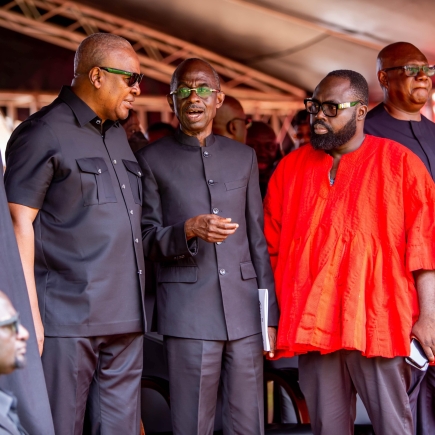
On the occasion of this year’s World Food Day, I attended an indoor rally organised by The Church of Pentecost Men’s Ministry (PEMEM) on October 16 at Nsawam.
It was not all talk.
There was an exhibition displaying crops and poultry products by church members, some of whom have, in their occupation as farmers, won awards at District Farmers’ Day events.
It is to this that I should have devoted this page today. But something else happened there.
The guest of honour was Dr Peter Boamah Otokunor, Director of Presidential Initiatives in Agriculture and Agribusiness (PIAA), Office of the President. O, my God, he spoke!
From what I heard, as the blueprint for the next agricultural revolution in Ghana, even the most incurable cynic would have clapped till their hands became sore.
What a message of hope! In my notebook, I wrote as follows: Operation Feed Yourself Reborn.
My prayer was that this was not one of those speeches from ministries or the Jubilee House, typically written for top-level policymakers by a Director of Agriculture.
Below, I will share sections of the speech that highlighted some of what he termed “transformative programmes” designed to empower youth, women and farmers by his office.
• The School Farm Initiative (SFI):
It is the best policy in 30 years. It seeks to reintroduce practical agriculture in schools to equip students with hands-on skills in farming, livestock management and agribusiness.
• The Youth Agriculture Estate Programme (YAEP):
Large-scale youth-managed estates will be established across the country for strategic crops such as maize, rice and vegetables, while providing access to land, irrigation and market linkages.
• The Poultry and Livestock “Farm-to-Table” Programme:
This is proposed to be a modern, youth-led livestock and poultry value chain that connects rearing, processing and distribution — enhancing nutrition and creating decent jobs.
• The Coconut, Cashew and Shea Value Chain Programmes.
Under this, women and youth will be empowered in value addition and processing to expand Ghana’s export base and create sustainable livelihoods.
• The Youth in Cocoa Farming Initiative:
Young people will be encouraged to embrace cocoa farming as a modern, technology-driven enterprise, ensuring generational continuity in one of our most valuable sectors.
• The Home and Community Gardening Initiative:
In partnership with faith-based organisations such as the Church of Pentecost, the government is introducing a national campaign to promote home gardening and community vegetable production.
Every home, every church, every school can become a centre of food production. Even a small backyard can grow tomatoes, peppers, okra or herbs that feed a family.
• Innovation as the Bridge to a Better Future
Through the PIAA, we are integrating digital technologies, data systems and agritech incubation hubs to make agriculture more efficient, climate-smart and profitable.
Comments by yours truly
Great words. I was bowled over. This is the future of agriculture. But how many “great” schemes have successive governments not put together, which, on paper, “wowed” everybody but ended up in the same hell-hole of hunger and impossible food prices?
With specific reference to the Youth Agriculture Estate Programme, I will beg to ask: are we going back to the Kwame Nkrumah State Farms cum Workers Brigade?
The concept, while it was great, left out the very component that killed it.
As journalist and PR guru Frank Apeagyei counselled in an article published in the ‘Daily Graphic’ three years ago, the State Farms failed because it introduced “formalised wage labour into agriculture”.
Frank’s analysis is that in principle, “You cannot make a farmer out of a salaried worker.”
Any farmer who does not own the land will farm on another person’s land and will, therefore, find farming not worth breaking their backs for.
Apeagyei’s proposal is for the government to apportion the lands to the youth “on ownership bases” either through leasing or by allodial title.
That alone guarantees commitment.
While at it, how about creating land banks for the distribution of land to the youth?
To our collective shame, Ghana’s agriculture still depends on rain.
We have paid lip service, for far too long, to the drainage system. Apeagyei asks: “What is the sense in allowing all our rivers to flow into the sea and only wait for rainfall to irrigate our farms?”
Isn’t it time we redirected our rivers and excess water from the Bagre and Weija dams to do the job of irrigating our farms?
Isn’t it a shame that we have sunk billions into the Pwalugu Multi-Purpose Dam and have got nothing out of it so far?
Also, I hope Otokunor has thought of warehouses and silos throughout the country to address post-harvest losses?
Have we thought of Mechanisation and Equipment Depots for the supply and maintenance of farm machinery and tools?
How are we going to guarantee the farmer's access to the market and a good price for their produce?
The issue of land is so critical that President Mahama must make a call to President Kagame on how Rwanda managed to bring all lands under government or state ownership.
The writer is the Executive Director,
Centre for Communication and Culture.
E-mail:
