
I had just returned from Dakar, Senegal, where I represented Ghana at the High-Level Panel deliberations on the Accra Reset, President John Dramani Mahama’s flagship continental initiative.
Throughout that journey, my companion was not a policy paper or a government briefing.
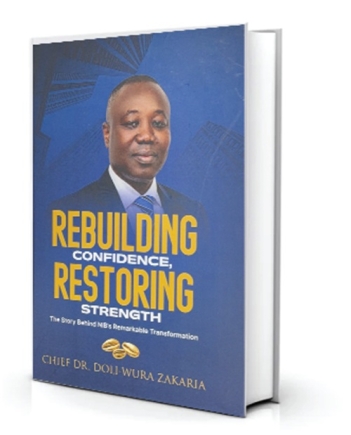
It was a newly published book, Rebuilding Confidence, Restoring Strength: The Story Behind NIB’s Remarkable Transformation by Chief Dr. Doliwura Awushi Abdul Malik Seidu Zakaria.
At first glance, the title suggests a book about a financial institution.
It is not, at least not in the way one might expect.
The National Investment Bank is the setting, but the book is really about the person entrusted with its revival.
It is about leadership under pressure, the discipline that precedes public success, and the habits of character that quietly shape institutions long before results become visible.
The story of the National Investment Bank begins in Chapter Nine.
By then, however, the reader has already travelled through the experiences that prepared Chief Doliwura for one of the most difficult assignments in Ghana’s banking sector.
That structure is one of the book’s greatest strengths. Rather than beginning with the crisis, it begins with the person who would eventually confront it.
When Chief Doliwura was appointed Managing Director of the National Investment Bank in January 2025, he inherited an institution facing profound challenges.
The bank carried negative equity of GHS850.6 million, a capital adequacy ratio of negative 46.96 per cent against the regulatory minimum of 13 per cent, and non-performing loans of 76.48 per cent.
It had not published audited accounts in more than a decade. Few would have considered it a story of possibility.
Yet, as the book records, the Bank looked markedly different one year later. Audited accounts had been published with an unmodified opinion from PricewaterhouseCoopers. Return on equity had risen to 22 per cent.
Customer deposits had grown by 58 per cent
Non-performing loans had begun to decline, and more than five hundred long-serving staff members had been promoted.
Those figures tell an important story.
They are, however, only the outcome.
The real story this book seeks to tell is how leadership, values, and disciplined execution made those outcomes possible.
The Story Behind the Numbers
Yet, if one reads this book only for the numbers, one misses its central message.
The audited accounts, the improved capital position, the growth in customer deposits and the renewed confidence of staff are the visible results.
The book is far more interested in the thinking that produced those results.
It examines the habits of leadership, the discipline of public service, and the institutional values that shaped every decision taken along the way.
The framework adopted for the turnaround is described in the book as the ‘Reset Agenda’ Strategy, built around five pillars: People, Performance, Premises, Assets, and Digital Transformation.
It is a practical framework, but it is also a reminder that institutional reform cannot be reduced to financial restructuring alone.
Sustainable change requires attention to people, systems, culture and purpose.
This is where the book distinguishes itself from many accounts of organisational transformation.
Rather than presenting success as a sequence of technica l interventions, Chief Doliwura demonstrates that institutions are ultimately shaped by the people who lead them and the values they choose to uphold.
Financial recovery is presented not as the starting point of reform, but as its consequence.
The book therefore invites the reader to look beyond balance sheets and performance indicators.
It asks a more enduring question: what kind of leadership is capable of restoring confidence where confidence has been lost?
That question becomes clearer as the narrative turns from the institution to the man entrusted with its renewal.
The man before the turnaround
The answer to that question begins long before the National Investment Bank.
It begins in Lamashegu, where the book introduces us to a young boy affectionately called “The Officer” by his siblings because of his unusual sense of order.
He kept his shirts neatly tucked, placed his shoes where they belonged, and developed habits of discipline long before he understood the language of leadership.
The stories from his childhood are among the most compelling parts of the book because they reveal how character is formed in ordinary moments.
As a young boy, Chief Doliwura sold kerosene and pushed handcarts in the market for a few pesewas.
Each evening, he carefully recorded every transaction in a notebook.
He noted what he had sold, who owed him money, and what his grandmother took as her share.
No one had taught him bookkeeping or accounting.
Yet, even at that age, he understood that every transaction mattered and that careful records made better decisions possible.
The lesson, as he reflects in the book, was never merely about money.
It was about dignity, discipline and the understanding that patterns can be observed, measured and improved.
That lesson followed him into public service decades later.
When he assumed office at the National Investment Bank, he looked beyond financial statements and performance reports.
He asked questions about staff attrition, organisational culture and the experiences of those working at the front line of the institution.
Having once pushed a handcart himself, he understood that institutions cannot succeed if they overlook the people who serve customers every day.
The book also introduces us to the influences that shaped his understanding of leadership.
His father, a former Member of Parliament who was detained without trial following the 1981 coup, returned to the classroom without bitterness.
One lesson remained with his son throughout his career: “What is unfinished does not disappear. It waits.”
It is a simple statement, yet one that echoes throughout the book as projects are completed, difficult decisions are confronted, and institutional problems are addressed rather than postponed.
There is another influence that quietly runs through the narrative.
As a traditional leader and for thirteen years Chief of Staff to his grandfather, the late Yagbonwura Tuntumba Boresa I, Chief Doliwura learnt lessons that no management textbook could teach.
Sitting beneath the dawadawa tree, he learnt patience, the value of listening before speaking, and the importance of understanding the history of a problem before attempting to solve it. Above all, he learnt that leadership is not sustained by authority alone.
It is sustained by the confidence of the people one serves.
These experiences explain why the National Investment Bank occupies only part of this story.
The turnaround did not begin with a board meeting or a financial strategy.
It began many years earlier, through the values, discipline and public service experience that prepared one individual for a moment of extraordinary responsibility.
Leadership beyond the balance sheet
One of the most refreshing aspects of this book is that it does not present institutional reform as a purely financial exercise.
The turnaround of the National Investment Bank was undoubtedly measured in improved financial performance, but the author makes it clear that sustainable reform begins with people, values and culture.
What struck me most was the emphasis placed on people.
Long before improved financial indicators began to emerge, the book describes deliberate efforts to restore the confidence of employees.
Staff promotions were reinstated.
Investment was made in the workforce. Expectations were raised alongside opportunities.
The underlying message is clear.
Institutions perform better when the people within them believe they are respected, valued and trusted.
The same philosophy runs through what Chief Doliwura describes as the institution’s operating system.
At its centre are three principles: Ubuntu, transparency and integrity.
Ubuntu is presented not as an abstract ideal but as a practical approach to leadership.
It recognises that institutions succeed because of the people who sustain them.
Transparency is reflected in the decision to publish audited accounts after more than a decade, even when the financial position remained difficult.
Integrity is treated not as a slogan but as a daily discipline, expressed through countless decisions that reinforce public trust over time.
Equally significant is the author’s willingness to acknowledge setbacks.
One example he recounts is the late submission of a routine prudential return to the Bank of Ghana in 2025, for which he personally accepted responsibility and apologised.
That honesty gives the book credibility.
It reminds the reader that institutional reform is rarely a straight line.
Progress is built not by pretending mistakes do not occur, but by confronting them openly and learning from them.
In many respects, this is what distinguishes Rebuilding Confidence, Restoring Strength from the typical leadership memoir.
It does not attempt to present an image of flawless leadership.
Instead, it offers a practical account of how discipline, accountability and consistency, applied over time, can restore confidence in an institution that many had written off.
Why this book matters
The measure of a good book is not simply the story it tells, but the questions it leaves with the reader. Rebuilding Confidence, Restoring Strength succeeds because it invites reflection well beyond the National Investment Bank.
The book is written with precision.
Before the narrative begins, the author sets out an Author’s Note and a Disclaimer, carefully distinguishing personal recollection from audited fact.
It is a simple decision, yet an important one.
A book about rebuilding confidence must itself be built on credibility, and this one is.
What stayed with me most, however, was the chapter on legacy.
Chief Doliwura argues that legacy is not measured by buildings, monuments or titles.
It is measured by what we leave behind in people.
It is the branch manager who continues to lead with confidence.
It is the young professional who carries forward the values of the institution long after today’s leaders have departed.
In one of the book’s most memorable observations, he reminds us that, “Your institution is not yours.
You are holding it for a period.”
Those words capture an important truth about leadership. Public office, corporate leadership and institutional responsibility are all forms of stewardship.
They are opportunities to strengthen institutions for those who will inherit them, rather than possessions to be protected for personal recognition.
Having known Chief Doliwura for some time, I found that the book confirmed many of the qualities I had already observed.
His steadiness, discipline and commitment to completing difficult tasks are evident throughout its pages.
What the book adds is the story behind those qualities.
It explains where they were formed, how they were tested, and why they became the foundation upon which one of Ghana’s most significant institutional turnarounds was built.
A book worth reading
There are books that describe events, and there are books that explain why those events happened.
Rebuilding Confidence, Restoring Strength belongs to the latter category.
Perhaps the greatest lesson is also the simplest. Institutions do not change because of slogans or declarations.
They change because leaders consistently make decisions that strengthen systems, build trust and place the long-term interests of the institution above personal recognition.
Chief Doliwura leaves the reader with three lessons that remain with me long after I closed the book.
Look at the books before you look in the mirror.
Pay the people before you ask them to perform.
Finish what is unfinished, because it does not disappear. It waits.
That, ultimately, is why I recommend this book. It is not simply the story of the National Investment Bank.
It is a thoughtful reflection on leadership, public service and institutional renewal.
It deserves to be read by everyone who believes that strong institutions remain the foundation of national development.
