
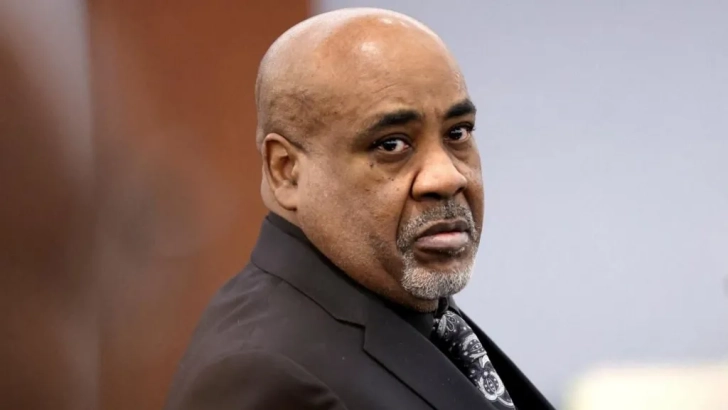
The conviction of Duane "Keffe D" Davis in Las Vegas has brought an end to one of the world's most famous unsolved murder cases.
He was found guilty of the murder of rapper Tupac Shakur, who died when the black BMW he was travelling in was sprayed with bullets in a drive-by shooting in 1996.
"This is huge. It was a tough case. It's a cold case," former prosecutor Neama Rahmani told the BBC. "We're talking about the greatest rapper of all time, an icon, and not a single arrest or prosecution for 30 years."
The conviction gives closure to Shakur's family, and has prompted questions from observers as to what it could mean for an almost identical case - the unsolved murder of Notorious B.I.G. or Biggie Smalls, also known by his legal name of Christopher Wallace.
Wallace, a New Yorker, was Shakur's big rival and the two rappers embodied the East Coast-West Coast feud that dominated 1990s hip-hop. Wallace was killed in Los Angeles a few months after Shakur and in similar circumstances - a drive-by shooting. No one has ever been charged.
It has long been believed the two murders were linked and Wallace's name came up a lot in the Duane Davis trial - he and Davis were at the same party the night Wallace was killed and Davis was interviewed by police about it. The investigator who conducted that interview even testified at the Tupac murder trial.
The breakthrough in finally solving the Shakur case largely came down to one thing: Davis' own words.
Through documentaries with the media, his own memoir, podcasts and even a secret police interview, he acknowledged his role in Shakur's death. Davis said he tossed a firearm in the backseat and his nephew, Orlando Anderson, used the gun to fatally shoot Shakur as they pulled up alongside his vehicle in Las Vegas on 7 September, 1996.
Anderson was shot dead in 1998, having denied killing Shakur.
During the trial, there were no eye-witnesses to place Davis as being in the car, no murder weapon presented, no video or photo evidence. His defence team went as far as to argue there wasn't even proof that he was in Las Vegas that night.
Rahmani said it was a difficult case to prosecute. He noted the rumours and speculation surrounding Davis were nothing new and had been around for decades - but the decision to charge him and go to trial was an "uphill climb" - a gutsy move - for prosecutors.
"Look, when you're a prosecutor, you're expected to win every time. They made a difficult decision to charge a case that a lot of people thought might be a loser," he explained. "And they got justice, where other people didn't even bother trying."
Davis' attorney Michael Sanft asked the jury to consider "what facts do you have?" He urged the panel, before they decided their guilty verdict, to discredit his client as a liar who told tales to sell books and make money.
"There's no proof," he argued to the jury.
