
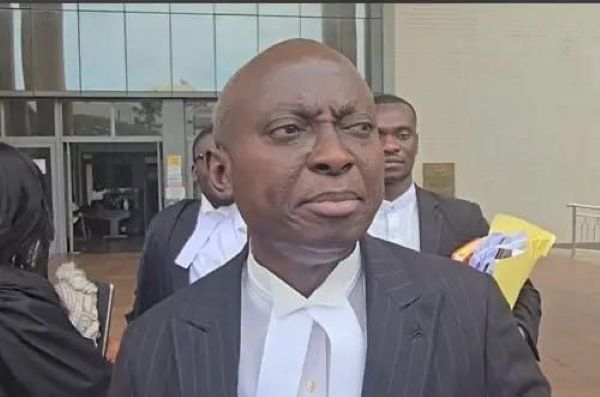
The Accra High Court has given counsel for the accused persons in the trial involving former Director-General of the National Signals Bureau (NSB), Kwabena Adu-Boahene, one more day to conclude his cross-examination of the fourth prosecution witness.
The court, presided over by Justice Francis Apangabuno Achibonga, granted the request after counsel, Samuel Atta Akyea, and the Deputy Attorney-General (A-G), Dr Justice Srem-Sai, approached the bench at the end of proceedings on Tuesday (September 1, 2026) to ask for an additional day.
In granting the latest request, the court recounted the several occasions on which it had given counsel additional time to conclude the cross-examination.
Cross-examination
Before the request for the additional day, Mr Atta-Akyea continued his cross-examination of the EOCO investigator, Frank Marshall Cromwell, focusing on bank accounts operated by the National Security Coordinator and the then Bureau of National Communications (BNC), now the NSB.
Mr Cromwell told the court that investigations had established that the National Security Coordinator had written a letter in 2017 for the opening of an operational account for the BNC at Fidelity Bank.
He said the National Security Coordinator was a co-signatory to the account, together with the then Director of the BNC.
The witness said investigations also established that BNC Communications Bureau Limited had opened an account at UMB in 2018 and another in 2020.
He said, unlike the Fidelity Bank account, there was no letter from the National Security Coordinator authorising the opening of the BNC Communications Bureau Limited account.
According to the witness, the private company had the first and second accused persons as its directors, and the second accused had denied knowledge of the company when confronted by investigators.
Three cheques
Mr Atta-Akyea also questioned the witness about three cheques of GH¢27.1 million, GH¢1 million and GH¢21 million drawn from the Fidelity Bank account.
The witness said investigators did not find request memoranda, payment vouchers or other authorisation documents underlying the cheques.
He said the Head of Finance of the NSB, Edith Adumua Opokua, told investigators that the first accused instructed her to write the cheques.
The witness further said he could not point to a specific request made to the NSB for the documents.
When counsel asked whether the witness could tell the court, from any authorising document, the purpose for which each of the three cheques was issued, he answered in the negative.
“No my Lord. Because no such document came into our possession during our investigation,” he said.
Account transactions
Mr Akyea also questioned the witness on transactions in the National Security Coordinator’s account at Fidelity Bank.
The witness acknowledged that the account contained numerous transactions, including cash deposits and withdrawals, but said he could not tell whether cash transactions were the dominant feature of the account.
He also acknowledged that investigators had not carried out a correlation between deposits and withdrawals from some of the accounts.
Asked whether investigators had enquired why private individuals were making deposits into an account described as a public account, the witness said there was nothing unusual about the account.
He maintained that the account was a public account because it was opened on the instructions of the National Security Coordinator, who was a co-signatory.
The witness further admitted that investigators had not investigated whether monies paid by private individuals into the National Security account, including funds from accounts linked to the accused persons, were subsequently refunded.
He also said there had been no advances to reconcile in relation to the transactions.
The case has been adjourned to September 2, 2026, for the continuation of the cross-examination.
