
Ending nation’s tech import dependency: Academic City University launches new programmes
Academic City University has launched seven new undergraduate and postgraduate programmes as part of efforts to help the country leverage its own natural and intellectual strength to create homegrown solutions towards development.
The programmes are BSc Data Science and Artificial Intelligence, BSc Nuclear Energy, BSc Unmanned Aerial Systems Engineering, MSc Management, MPhil Robotics, and STEM MBA.
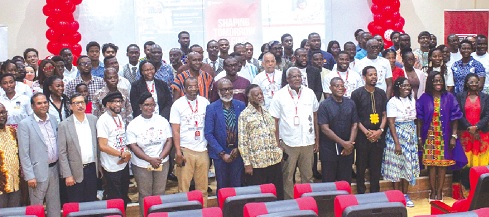
The new programmes were unveiled at a launch ceremony attended by industry leaders, academics and government representatives at the school’s premises last Friday.
Approach
The President of Academic City University, Professor Fred McBagonluri, said the seven programmes were aligned with its vision 2030 strategy and were designed around core areas identified as rapidly evolving in both the Ghanaian and global economies.
He stated that the country routinely failed to build centres of excellence in sectors where it already held a natural global advantage.
“Ghana is the number one cocoa producer in the world, yet everything we need to know about cocoa — the science, the processing, the economics — that should be housed here is not.
“We need to be intentional about how we develop this country,” he said.
He said the programmes were designed around three pivots, which are educating to enhance Ghana's existing strengths, educating to solve the country's specific problems, and producing the leadership required to drive both.
"We no longer have to wait for technology to be deployed elsewhere so that we can go for them. We can do them from here," he said, adding that Ghana continued to discuss the problem of energy without producing engineers trained in alternative energy solutions.
Case
Making a case for the introductions of the programmes, Prof. McBagonluri said nuclear power, for instance, represented an indispensable component of Ghana's future energy mix and stressed that its applications extended beyond electricity generation into the field of medicine.
"Going nuclear means we have industry partners and in-house expertise," he said, thanking the Ghana Atomic Energy Commission for what he described as close collaboration with the university in developing the programme.
On unmanned aerial systems, Prof. McBagonluri argued that while Ghanaian children played with drones as toys, other countries were deploying the same technology for medicine delivery, agricultural pest monitoring and border security.
He recounted meeting a start-up in India that was using drone systems combined with artificial intelligence to monitor the border between Pakistan and India, with the system capable of identifying suspicious human movement in real time.
Prof. McBagonluri disclosed that a major company from Nigeria had announced plans to begin manufacturing drones in Ghana, and that the university expected to produce its first graduates in time to meet that company's manpower needs.
Robotics
On robotics, the University President said the new MPhil and MSc Robotics Engineering programmes were designed to build a domestic faculty pipeline and position Ghana to leapfrog into advanced manufacturing without retracing the decades-long industrialisation path taken by countries like China.
Prof. McBagonluri said the STEM MBA was conceived specifically to address what he described as a leadership deficit in Ghana's economy.
He said the traditional MBA was inadequate for an age defined by data and AI, stating that future industry leaders must be able to use data for complex decision-making — a skill he said he encountered only after pursuing an MBA at MIT's Sloan School of Management following his PhD in engineering.
"In this age of data and artificial intelligence, you are looking for the next generation of industry leaders who can actually use data to make informed decisions. You need strong computational power.
That is lacking in the traditional MBA programmes," he said.
Engineering
A former President of the Ghana Institution of Engineering, Dr Kwame Boakye, who also spoke at the event, warned that manufacturing in Ghana was nearing extinction and urged the younger generation to embrace engineering as an urgent national priority.
"We can pray every day, but if we do not embrace engineering, we are not going anywhere.
We must infuse new blood into the profession.
As senior citizens leave, the next generation must grow the profession,” he said.
