
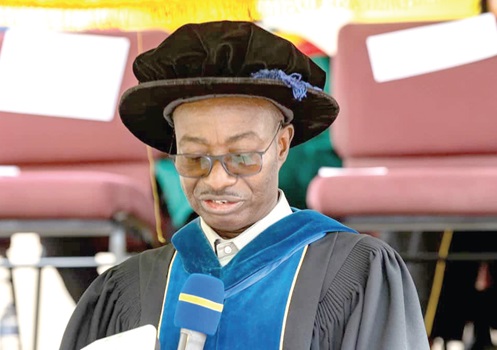
Private universities not substitute for public institutions — ANU President
The President of the All Nations University (ANU), Professor Samuel Herbert Donkor, has stated that private universities are not substitutes for public tertiary educational institutions but complementary forces, which propel national progress.
He stated that private universities should not be viewed as profit-driven enterprises and must therefore, be recognised as mission-driven educational institutions investing in Ghana’s future.
Professor Donkor, who is also the founder of the university, made this assessment at the 34th graduation ceremony of the ANU held at Koforidua, the Eastern Regional capital.
The joyous occasion, held on the theme: "Private universities in nation building: Changing the narrative", witnessed the passing-out of 562 graduates, comprising 216 males and 346 females.
The graduating students pursued programmes in Biomedical Engineering, General Nursing, Accounting, Banking and Finance and Entrepreneurship, Marketing, Computer Engineering, Computer Science, Electronics and Communications Engineering.
The rest of the programmes are Oil and Gas Engineering, Biblical Studies and Business Administration.
Measurable impact
Professor Donkor stated that universities in general should collectively evolve from mere access to measurable impact institutional growth to national leadership, training for employment to cultivate innovation and entrepreneurship, knowledge consumption to knowledge creation and from local relevance to global competitiveness.

The new graduates in Koforidua
He said in view of that the ANU had mounted a new programme dubbed, “Total Personality Development,” to imbibe in the students, a holistic approach, which transcended traditional education.
That approach, Professor Donkor indicated, ensured that ANU graduates emerged not merely as degree holders, but as renaissance individuals, intellectually astute, spiritually grounded, emotionally intelligent, physically vibrant and socially conscious.
Challenging world
The ANU President reminded the graduates that they were stepping into a world of unprecedented challenges such as economic uncertainties that tested resilience, technological disruptions that demanded adaptations, climate change and social inequalities.
Professor Donkor indicated that with education and training at the ANU, they would be able to find solutions to such problems wherever they may be.
He said earlier graduates of the institute had already made history because engineers among them were able to put a satellite into space, making Ghana the first African country to do so.
The Chief Medical Officer of ITC India, Dr Sunil Thomas Chandy, said the education acquired by the graduates would expand beyond their narrow domains into the people's orientation, consciousness and stewardship.
Dr Chandy reminded the graduates that there would be a time when money, professional success, curriculum vitae and publications would cease to matter, adding that they would have to give back to society.
That, he explained, would determine their sense of self-actualisation and fulfilment.
Dr Chandy told the graduates that when they finally retired from work and dusted their offices for the last time, they would then look at the degree certificates they acquired and proudly indicate that they had lived the vision of the ANU.
Valedictorian
In her valedictory speech, Esther Doe Atsu, who studied Biomedical Engineering, said although her programme was challenging, with patience, perseverance and hard work and with the assistance of others as well as the lecturers, she was able to complete it.
She said the lecturers and mentors were able to guide the students through their challenges which inspired them to grow not only academically, but also as people with integrity and purpose.
Writer's email
