
Use technology to uplift communities, build prosperous Ghana - Graduates charged
The Deputy Minister of Education, Dr Clement Abas Apaak, has challenged graduating students of the Ghana Communication Technology University (GCTU) to apply their technological expertise to advance national development, promote inclusion and uplift underserved communities.
He said the nation was in an era where innovation was the “primary currency” of national progress and technologies, such as fintech, artificial intelligence (AI) and digital tools, were transforming financial systems, healthcare delivery, governance and education.
“Innovation must function as a bridge. We must connect rural communities to global opportunities, encourage girls in STEM and ensure persons with disabilities can access knowledge with dignity. Our progress must be equitable. A sustainable future for Ghana requires a foundation of equality,” he stressed.
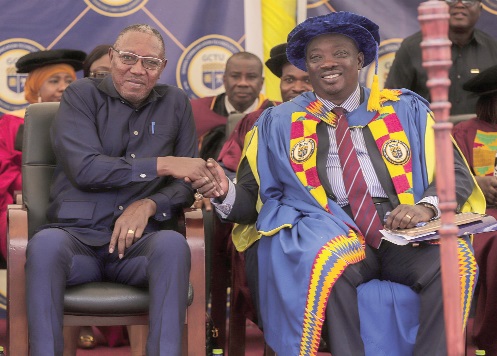
Dr Apaak, who is also the Member of Parliament (MP) for Builsa South, was speaking on behalf of the Minister of Education, Haruna Iddrisu, at the university’s 35th congregation ceremony held on the theme: “Innovating for tomorrow: Inclusive education and technology for a sustainable future in Ghana.”
In all, 2,121 students, spanning computing and information systems, engineering, business, distance education and postgraduate programmes, graduated.
Students who performed exceptionally received special prizes and awards in recognition of their hard work and dedication.
Government efforts
The Busila South MP said the government, under the leadership of John Dramani Mahama, was deepening investments in digital infrastructure in underserved districts, accessible curricula with local language support, assistive devices for persons with disabilities and targeted teacher training for inclusive digital instruction.
Charge to innovate
Dr Apaak, therefore, urged the graduates to design universal digital solutions, including accessible portals, adaptive testing systems and captioned lessons, that guaranteed equitable learning.
He also called on them to focus on sustainability by developing green technologies, supporting smart agriculture for food security, improving digital governance and tackling challenges such as waste management.
Emphasising the African Union’s Agenda 2063, he reminded the graduates that the future belonged to innovators, powered by empathy, integrity and service, and encouraged them to think inclusively, build sustainably and support others as they progress.
“Ghana cannot import sustainability.
We must invent it.
The nation is relying on your creativity to build a greener, more digital and prosperous nation. Do not wait for permission to lead.
The future is not a distant concept. It is here and firmly in your hands,” Dr Apaak said.
Infrastructural gains
The Vice-Chancellor, Professor Emmanuel Ohene Afoakwa, enumerated major infrastructure gains that were driving the university’s transformation into the country’s emerging “Silicon Valley.”
He announced the near completion of an eight-storey lecture and office complex and a six-storey graduate school expansion, with a 4,000-bed hostel project set to begin next year through a public-private partnership.
“In the next 10 years, you will not have fewer than 12 different eight-storey blocks on this campus.
And you won't get anywhere in Ghana that you will get high-profile innovation and a high-class technological institution than this great institution,” he said.
